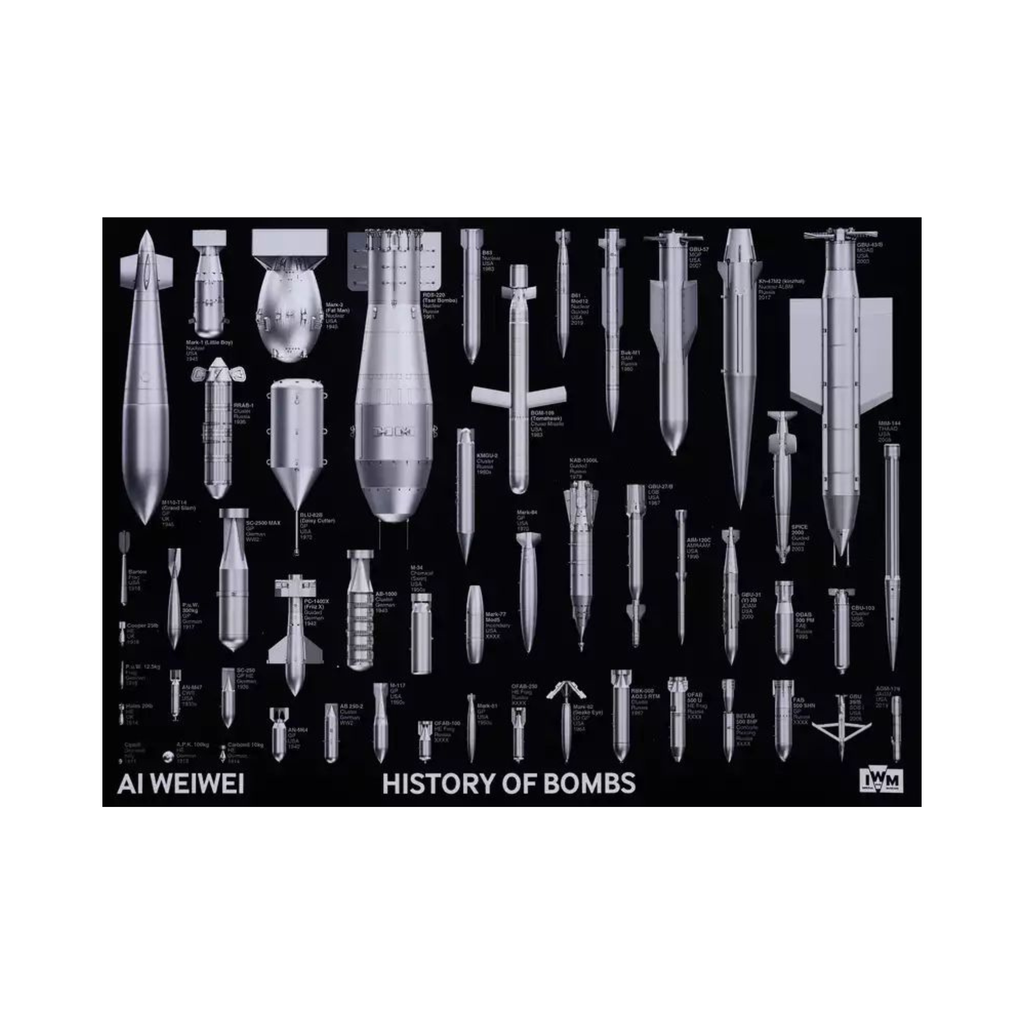
Ai Weiwei
History of Bombs
2020
Digital print (Print-Multiple)
50 × 70 cm
Ed. /200
Location: Paris, France
Documents
-
Invoice or proof of purchase
-
Certificate of authenticity
-
Other documents
About the artwork
Ai Weiwei’s “History of Bombs” is a visually striking and politically charged digital print that catalogues a wide array of aerial bombs used throughout modern warfare. Presented on a stark black background, the work arranges dozens of bomb forms in clean, technical silhouettes, each identified by name or model. The cold precision of the renderings echoes the clinical detachment with which destructive technology is often discussed, transforming weapons of mass devastation into objects of unsettling formal beauty.
The print highlights Ai Weiwei’s ongoing engagement with themes of violence, power and state control. By presenting weapons as an orderly inventory, he confronts viewers with the normalization of military force and the hidden systems that shape global conflict. The piece is both archival and accusatory, inviting reflection on humanity’s long and troubling relationship with warfare.
Expert opinion
“History of Bombs” is widely considered one of Ai Weiwei’s most incisive graphic works of recent years. The print distills the artist’s critical voice into a format that is simultaneously accessible and conceptually powerful. Its documentary aesthetic recalls institutional displays found in military museums, yet Ai Weiwei subverts that neutrality by exposing the scale and variety of instruments designed for destruction.
As an edition of 200, this signed print holds strong appeal for collectors seeking politically relevant contemporary art. Its importance is amplified by the global debates surrounding war, surveillance and state violence, which continue to define Ai Weiwei’s practice. The work stands as a poignant and timely reminder of the human cost embedded in technologies we too often regard with detachment.
About the artist
Ai Weiwei (born 1957 in Beijing, China) is a Chinese artist and activist living and working in Berlin, Cambridge, and Portugal. He studied animation at the Beijing Film Academy and became a founding member of the Stars Art Group in 1979, which challenged artistic restrictions in post-Mao China. After moving to New York in 1981, he engaged with Western art movements, particularly conceptual art and minimalism. Returning to China in the early 1990s, Ai established himself as a key figure in contemporary art with a multidisciplinary practice that includes sculpture, installation, photography, architecture, social media, and filmmaking. His work often utilizes everyday materials such as Lego bricks, porcelain, and found objects to address themes of identity, history, human rights, and state control. Notable projects include installations like Sunflower Seeds and Straight, which reflect on significant social issues. Ai's outspoken criticism of the Chinese government led to his arrest and imprisonment in 2011, increasing his international visibility. His works are part of major collections in institutions such as the Tate, MoMA, the Metropolitan Museum of Art, and the Centre Pompidou.
Additional info
Signed
3x
OTHER ARTWORKS YOU MAY LIKE
Your Dynamic Snippet will be displayed here...
This message is displayed because you did not provide both a filter and a template to use.