Invader x Shepard Fairey (OBEY)
Positive Space
2025
53 × 72 cm
Ed. /250
Location: Hong Kong SAR
Documents
-
Invoice or proof of purchase
-
Certificate of authenticity
-
Other documents
About the artwork
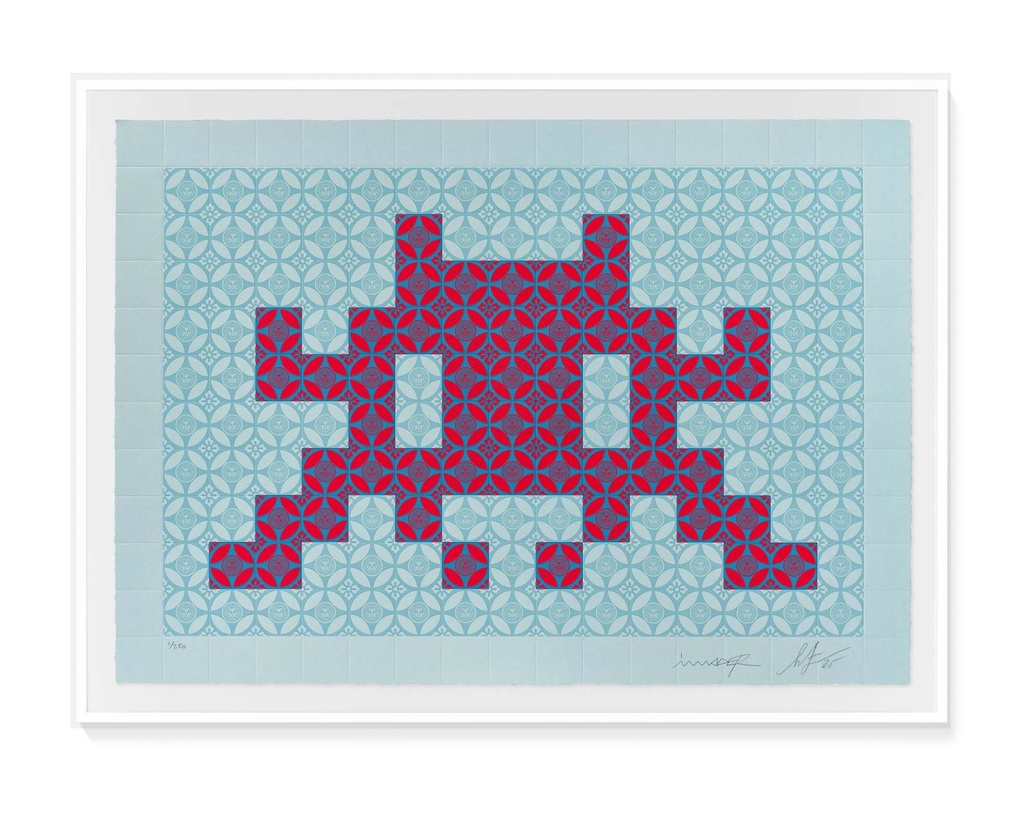
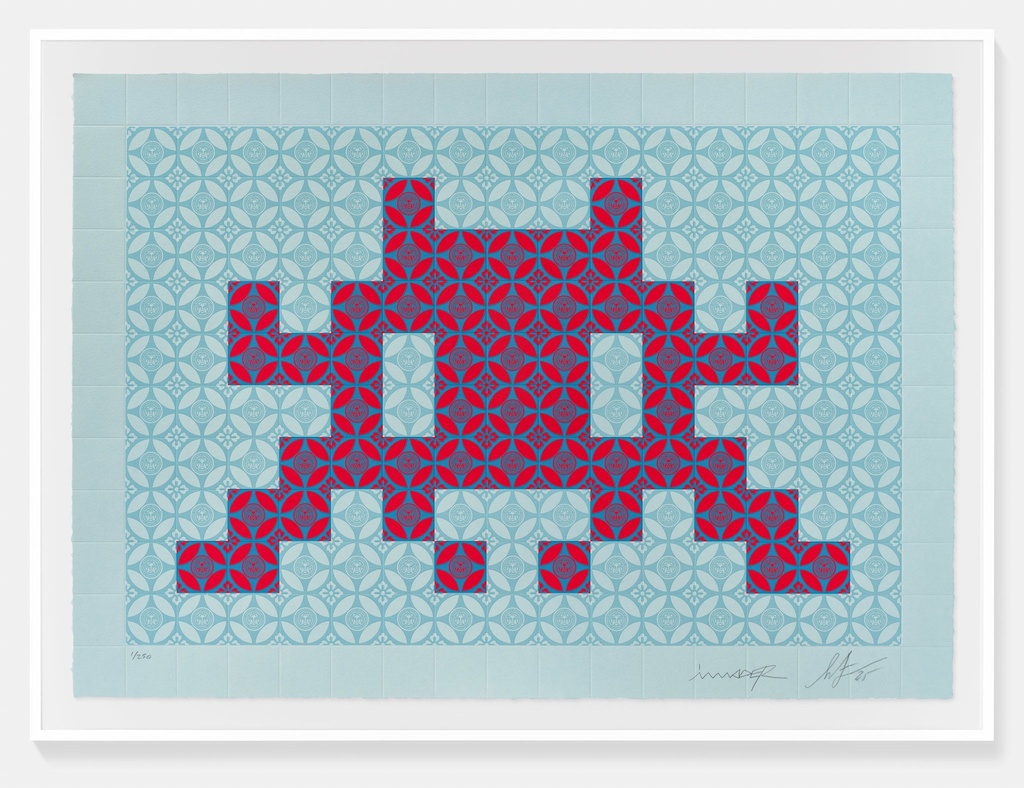
Positive Space Negative Space TT1 2 is a silkscreen print created in 2025 by Invader in collaboration with Shepard Fairey (OBEY). Printed in an edition of 250 on cotton paper, the work features embossing that subtly structures the surface and reinforces the graphic presence of the composition. The piece features the iconic Invader figure, inspired by the pixelated characters of the video game Space Invaders, here deployed in a geometric composition built on the opposition between positive and negative space. The red silhouette, composed of repetitive circular modules, stands out against a pale blue background adorned with a decorative motif reminiscent of the graphic ornaments characteristic of Shepard Fairey's visual language. The work thus plays on the tension between the pixelated rigidity of Invader's motif and the more fluid, repetitive ornamental structures of OBEY's graphic universe. The chromatic contrast between bright red and light blue accentuates the legibility of the central shape, while creating a visual dialogue between digital culture, urban aesthetics and graphic design. The embossing adds a tactile dimension to the whole, emphasizing the lines of the composition and reinforcing the impression of relief. Through this collaboration, the work proposes a synthesis between two major universes of contemporary urban art: that of Invader, rooted in pixel culture and video games, and that of Shepard Fairey, marked by the heritage of political graphics and reinterpreted propaganda imagery.
Expert opinion
This edition perfectly illustrates the encounter between two major figures in international urban art. Invader and Shepard Fairey are among the artists who have helped bring street art into the institutional arena and into the contemporary art market. The collaboration between these two artists is of particular interest, as it brings together two highly identifiable visual languages. On the one hand, Invader's conceptual approach, based on the logic of the pixel and the occupation of urban space by his mosaics. On the other, Shepard Fairey's graphic aesthetic, inherited from design, militant screen-printing and the visual culture of propaganda. The title Positive Space Negative Space underlines a fundamental principle of graphic design and composition. The work explores precisely this tension between form and content, between the appearance and disappearance of the figure, creating a dynamic visual reading in which Invader's icon seems to emerge from the decorative motif. Editions resulting from collaborations between major street art artists generally attract sustained interest from collectors. In this case, the combination of a limited edition, an embossed silkscreen technique and the signatures of two emblematic artists reinforces the work's market appeal. Positive Space Negative Space TT1 2 thus follows in the footsteps of the major editions produced by these artists, while testifying to the vitality and evolution of street art towards hybrid forms combining graphic design, digital culture and contemporary art.
About the artist
The collaboration between Invader and Shepard Fairey brings together two major figures in contemporary urban art, each having developed an immediately recognizable visual language that has had a profound influence on the evolution of street art since the 1990s.
Invader, a French artist active since the late 1990s, is known for his urban interventions inspired by the pixelated graphics of the video game Space Invaders. His mosaics, installed in cities around the world, transform public space into an artistic playground, and constitute a vast project of global artistic "invasion". His work questions the relationship between digital culture, urban space and collective memory, while introducing a simple yet universally identifiable iconography into the city.
Shepard Fairey, for his part, has established himself as one of the most important figures in contemporary street and graphic art. Revealed in the late 1980s with the OBEY Giant project, he developed an aesthetic influenced by political propaganda, militant graphic design and popular imagery. His work often blends political messages, social commitment and visual power, as exemplified by the Hope poster for Barack Obama's 2008 presidential campaign.
The encounter between these two artists is particularly relevant, as their universes are based on complementary approaches to the image. Invader builds his language on pixels, modularity and the logic of video games, while Shepard Fairey develops a graphic aesthetic inspired by screen printing, design and the visual codes of political communication.
In their collaborations, these two approaches merge to produce works in which the iconic Invader figure is embedded in the ornamental and graphic structures characteristic of the OBEY universe. This dialogue between pixel and decorative motif, between digital culture and militant graphic design, reflects the evolution of street art into a hybrid artistic practice, capable of integrating different visual traditions while retaining the energy and critical spirit of its urban origins.
Their collaboration illustrates how artists from the street art scene continue to renew their languages by crossing their influences and visual universes, while affirming the place of this culture in the contemporary art landscape.
Additional info
Signed
OTHER ARTWORKS YOU MAY LIKE
Your Dynamic Snippet will be displayed here...
This message is displayed because you did not provide both a filter and a template to use.