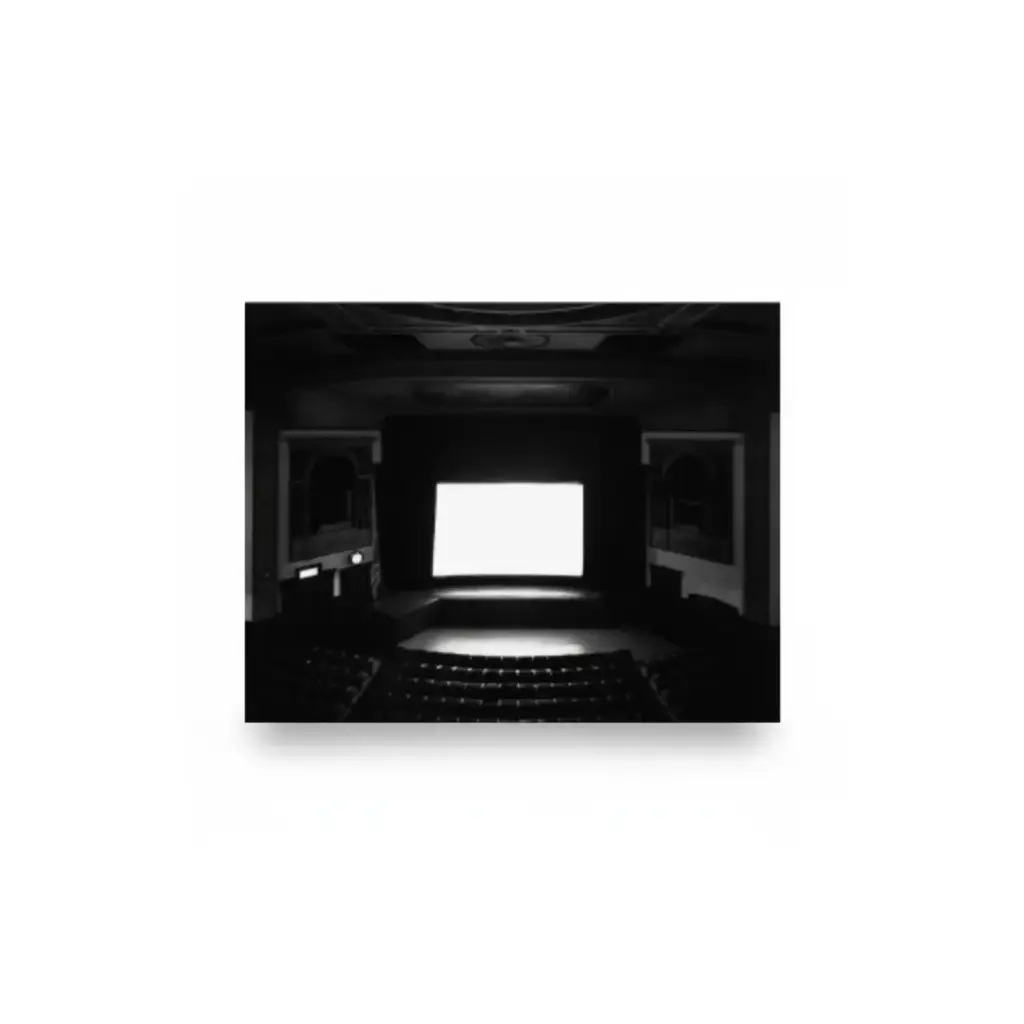
Hiroshi Sugimoto
Palace, New Jersey
1977
gelatin silver print
42 × 54 cm
Ed. /25
Location: Clichy, France

Arianee token ID
420452878
Share by
Email
Documents
-
Invoice or proof of purchase
-
Certificate of authenticity
-
Other documents
About the artwork
The interior of a classic movie palace is depicted in this gelatin silver print, with rows of empty seats leading towards a luminous, rectangular screen. The architectural details of the theater, including ornate moldings and ceiling elements, are visible in the dim light surrounding the central bright rectangle. The composition is monochromatic, emphasizing form and light. This work belongs to Sugimoto's "Theaters" series, initiated in the late 1970s, which explores the concept of time and the experience of cinema. For these photographs, Sugimoto used a large-format camera and a long exposure time, precisely matching the duration of an entire film being projected. This technique results in a screen that appears as a blank, glowing white rectangle, effectively collapsing the entire moving image content of the film into a single static frame. The series examines the architectural spaces of movie theaters, from grand Art Deco palaces to drive-ins, transforming them into contemplative studies of light, space, and the passage of time. By rendering the screen as pure light, the work shifts focus from the film's narrative to the physical space of viewing and the temporal act of watching. The empty auditorium and the illuminated screen evoke a sense of absence and the collective memory associated with these cultural spaces.
Expert opinion
This work is part of Hiroshi Sugimoto's "Theaters" series, which holds a central position within his oeuvre and in the broader context of conceptual photography. The series is recognized for its technical precision and its philosophical engagement with time, perception, and the photographic medium itself. By using extended exposures to capture the entire duration of a film, Sugimoto transforms the cinematic experience into a singular, static image, challenging conventional notions of photography as a medium that captures a fleeting moment. This approach positions the work within a lineage of artists who explore the boundaries of photographic representation and the relationship between reality and illusion. In the art market, works from the "Theaters" series are consistently sought after. As a foundational series for the artist, prints like this one are considered important examples of his conceptual practice. The market for Sugimoto's photography is international and robust, supported by his presence in major museum collections and consistent exhibition history. The value of individual prints is influenced by factors such as the specific theater depicted, the print size, its condition, and its edition number.
About the artist
Hiroshi Sugimoto, born in Tokyo in 1948, is a Japanese photographer and architect known for his exploration of themes related to time, memory, and the nature of reality. He initially studied economics at St. Paul's University in Tokyo before moving to Los Angeles in 1971 to pursue a BFA in Fine Arts at the Art Center College of Design. Sugimoto settled in New York City in 1974, where he also worked as a dealer of Japanese antiquities. His multidisciplinary practice extends to sculpture, performing arts production, and architecture, leading the Tokyo-based architectural firm New Material Research Laboratory. Sugimoto's photographic career, active since the 1970s, is characterized by a meticulous approach and the use of a large-format camera, often employing long exposure times. This technique allows him to capture the essence of his subjects, creating images that blur distinctions between the real and the fictive. His key photographic series include "Dioramas" (begun 1974), "Theaters" (begun 1976-1978), "Seascapes" (begun 1980s), and "Architecture" (begun 1997). He has received numerous awards, including the Hasselblad Foundation International Award in Photography in 2001 and the Praemium Imperiale Award for Painting in 2009. His work is held in the collections of institutions such as MoMA, the Metropolitan Museum, and the Art Institute of Chicago.
Additional info
3x
OTHER ARTWORKS YOU MAY LIKE
Your Dynamic Snippet will be displayed here...
This message is displayed because you did not provide both a filter and a template to use.