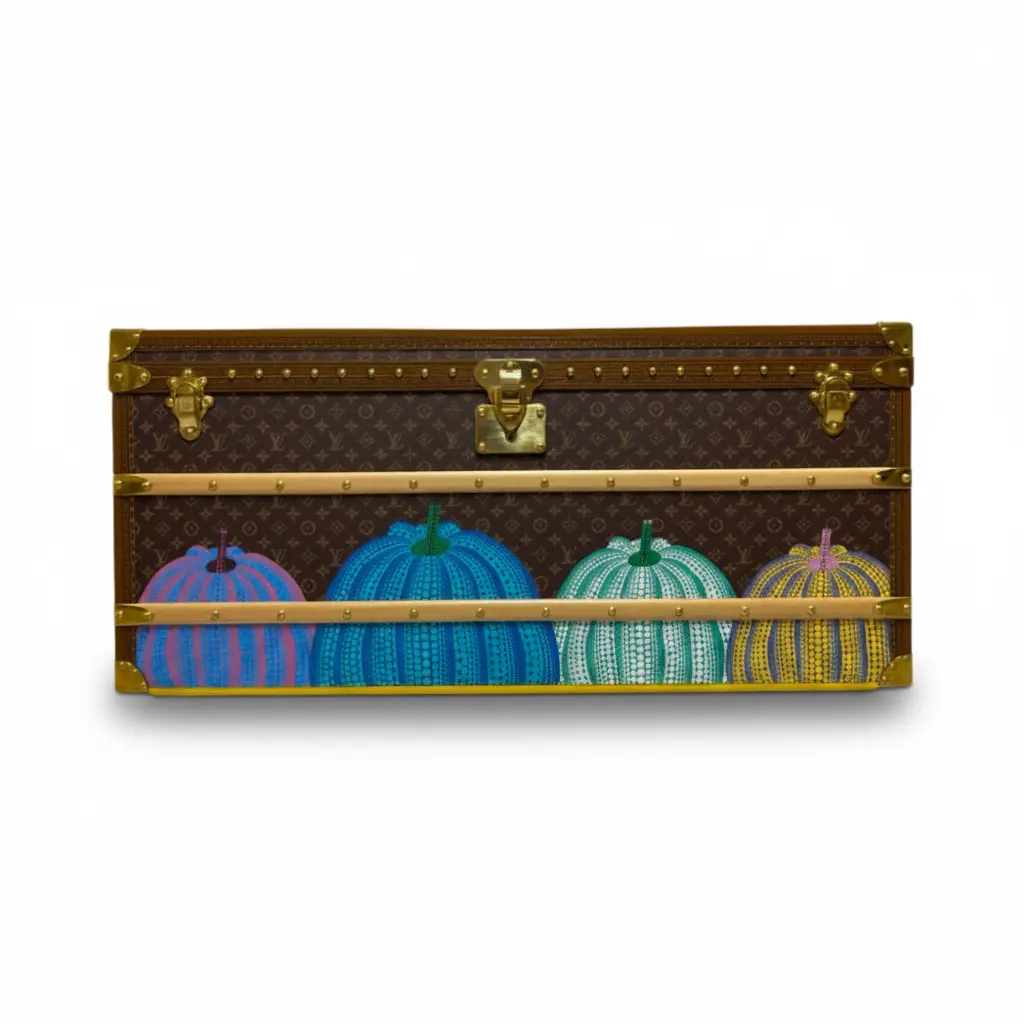
Yayoi Kusama
Malle Courrier Lozine 110
2023
wood trunk made of wood, aluminum, polymer, leather, coated canvas, and metal
52 × 115 × 58 cm
Unique
Location: Clichy, France

Arianee token ID
495396888
Share by
Email
Documents
-
Invoice or proof of purchase
-
Certificate of authenticity
-
Other documents
About the artwork
This large-scale trunk features a classic Louis Vuitton Monogram canvas exterior, adorned with a series of four painted pumpkins across its front. Each pumpkin is rendered in a distinct color palette, blue, green, yellow, and pink, and is covered with the artist's signature polka dots, which vary in size and arrangement. The pumpkins are arranged horizontally, creating a visual rhythm against the brown monogram background and the light wood and brass trim of the trunk. The collaboration between Louis Vuitton and Yayoi Kusama, launched in 2023, marks a continuation of their partnership that began in 2012. This particular piece integrates Kusama's iconic pumpkin motif, a recurring symbol in her oeuvre since the 1950s, with Louis Vuitton's heritage trunk design. The pumpkins, for Kusama, symbolize comfort, modesty, and a connection to her childhood experiences growing up on a plant nursery in rural Japan. They also serve as a vehicle for her exploration of repetitive patterns and themes of infinity, often linked to her personal experiences with hallucinations. The trunk itself, a "Malle Courrier Lozine 110," is a traditional Louis Vuitton model known for its craftsmanship, featuring natural cowhide leather handles and lozine, wooden slats, a lock closure, and a quilted cotton lining. The application of Kusama's vibrant, dotted pumpkins transforms this functional luxury item into an art object, bridging the realms of high fashion and contemporary art. The piece reflects a dialogue between Louis Vuitton's historical savoir-faire and Kusama's distinctive artistic language.
Expert opinion
The collaboration between Louis Vuitton and Yayoi Kusama represents a strategic intersection of luxury fashion and contemporary art, a practice Louis Vuitton has engaged in with various artists since the early 2000s. Such collaborations typically generate considerable market interest due to the combined brand recognition and artistic cachet. This artwork positions itself within the market for collectible design and art objects, appealing to collectors who appreciate both the heritage of Louis Vuitton and the established artistic identity of Kusama. Yayoi Kusama's market presence is substantial, with her works consistently achieving high prices at auction, particularly her "Pumpkin" and "Infinity Net" series. Her market is characterized by strong demand, especially in Asia, and her ability to maintain value across different mediums and price points. This specific piece, being a unique painted trunk rather than a mass-produced item, occupies a particular niche within her collaborative output, potentially commanding a premium due to its bespoke nature and the direct application of her artistic style onto a luxury object.
About the artist
Born in 1929 in Matsumoto (Japan), Yayoi Kusama is an emblematic artist of contemporary art living in Japan. Fascinated by peas, she discovered her artistic talent at the age of 10, producing watercolors, oil paintings and pastels. After training in traditional and modern painting, in 1958 she moved to New York, where she rubbed shoulders with such avant-garde names as Yves Klein and Andy Warhol. Influenced by the struggle for women's rights and freedom, the artist became known for her nude appearances in iconic New York locations. Her psychosomatic art, characterized by an abundance of polka dots, pursued her from an early age and made her an artist who participated indirectly in the Psychedelic and Pop Art movements. Since the 70s, the artist has lived in a psychiatric hospital, where she has her own studio. Indeed, her mental health was an integral part of her artistic practice. By the end of the 80s, she was already exhibiting in major museums around the world. In 2017, she opened her own museum in Tokyo. Now listed as the world's 8th most expensive artist, she is considered one of the most influential.
Additional info
3x
OTHER ARTWORKS YOU MAY LIKE
Your Dynamic Snippet will be displayed here...
This message is displayed because you did not provide both a filter and a template to use.