Jinoos Taghizadeh
Musem of Natural national Heritage
25 × 25 × 44 cm
Unique
Location: London, United Kingdom

Arianee token ID
705220887
Share by
Email
About the artwork
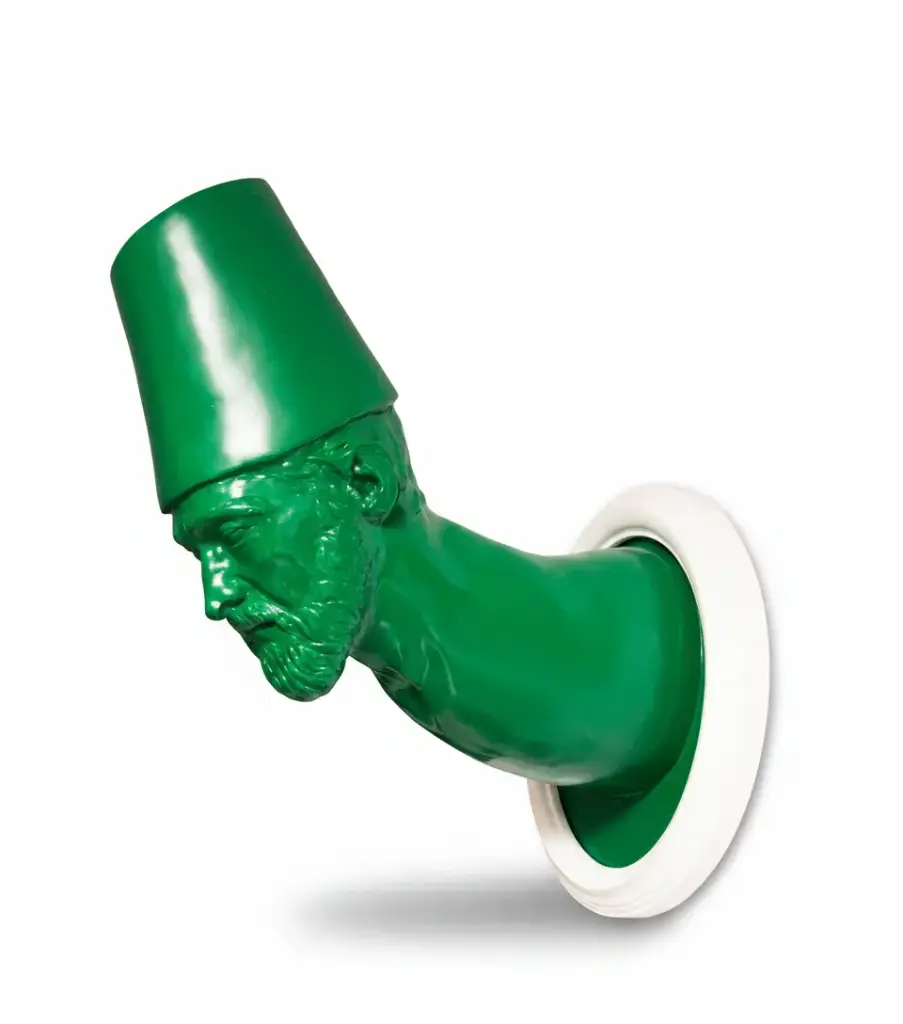
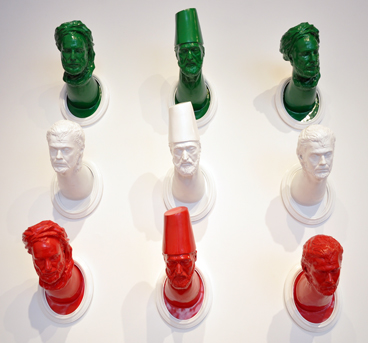
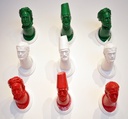
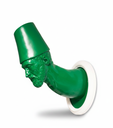
In this installation titled “National Natural Heritage Museum,” Jinoos Taghizadeh examines, with irony and clarity, the mechanisms of collective memory, power, and national identity. The work consists of nine busts arranged in three rows, painted in the colors of the Iranian flag—green, white, and red—evoking both patriotic pride and the symbolic rigidity of official representation. These male figures, which emerge from the wall like taxidermied specimens, are reminiscent of both natural history galleries and state museums, where memory becomes a political tool. Among them, the green bust in the front row depicts Amir Kabir, the famous 19th-century reformer executed on the Shah’s orders, a tragic figure of Iran’s aborted modernization. Through this gesture, Taghizadeh re-inscribes historical figures within a critical framework where glorification, disappearance, and fossilization merge.
The busts, stripped of their pedestals and embedded directly into the wall, seem literally absorbed by the museum’s display. The artist thus transforms the very concept of the museum—which is supposed to preserve and transmit—into a space for exhibition and questioning: what remains of national heritage when it is frozen in time, instrumentalized, or stripped of its complexity? The repetition of forms and the rigor of the installation suggest a standardization of narratives, while color serves as a visual code for national ideology.
Expert opinion
“Museum of Natural National Heritage” is a major work in Jinoos Taghizadeh’s career, emblematic of her ability to combine political critique, humor, and conceptual rigor. By playing on the conventions of the museum, taxidermy, and the monument, the artist offers a reflection of rare insight into the construction of Iran’s collective identity. Each bust embodies a fragment of history—an individual reduced to an emblematic figure, then neutralized by repetition and chromatic codification. The choice of green for Amir Kabir—a symbol of both hope and idealism—lends the work a poignant dimension: that of a memory rehabilitated yet still threatened with erasure.
The power of this installation lies in the tension it creates between visual appeal and critical unease. The glossy busts, almost seductive in their finish, become objects of ambiguous contemplation: somewhere between homage and derision, between frozen memory and living history. True to her commitment, Taghizadeh denounces the way nationalism transforms heroes into artifacts, into inert specimens of a “natural history” of power. With this work, she reaffirms the role of art as a space for intellectual resistance—an alternative museum where memory regains its critical vitality and its lost humanity.
About the artist
Jinoos Taghizadeh (b. 1971, Tehran, Iran) is one of the most influential Iranian multidisciplinary artists, activists, writers and editors of her generation. Involved in the contemporary art scene for almost thirty years, she began her career in 1984 and quickly established herself as a major figure in Iranian conceptual and engaged art. With a degree in sculpture from Tehran University (2000) and a diploma in dramatic literature from the Niavaran Cultural Center, she has developed a protean artistic practice that spans sculpture, painting, video, performance, installation and printmaking. Her works boldly address political, social and environmental issues, while highlighting the condition of women and the silent zones of contemporary Iranian history.
Her work has been shown in many prestigious institutions and international exhibitions, including the Chelsea Museum (New York), the MAXXI Museum (Rome), the Whitechapel Gallery (London), and the Kunsthalle Wiesbaden (Germany), where she enjoyed a major solo exhibition in 2016. In Iran, she took part in the first exhibition of conceptual art at the Museum of Contemporary Art in Teheran in 2000. Her most notable solo exhibitions include Letters I Never Wrote (Stiftelsen 3,14 Gallery, Bergen, 2017), Open Wiring (O Gallery, Tehran, 2015) and Hinterland Gallery (Vienna, 2019). Her work has also been featured in numerous collective projects such as Iran Inside Out (Chelsea Art Museum, 2009) and several Tehran Sculpture Biennials. The recipient of prestigious international residencies, including the Royal Hibernian Academy in Dublin (2017), the Villa Empain - Fondation Boghossian (Brussels, 2018) and the Banff Centre (Canada, 2023), she embodies a singular and courageous voice, at the crossroads of art, memory and resistance. In 2018, an educational salon at Bergen's Faculty of Fine Arts was named "Jinoos Room" in her honor, enshrining her lasting influence on the international art scene.
OTHER ARTWORKS YOU MAY LIKE
Your Dynamic Snippet will be displayed here...
This message is displayed because you did not provide both a filter and a template to use.