

Kambiz Sabri
Red Dive
2006
Fiberglass
55 × 42 × 32 cm
Ed. 1/2
Location: London, United Kingdom

Arianee token ID
845213311
Share by
Email
Documents
-
Invoice or proof of purchase
-
Certificate of authenticity
-
Other documents
About the artwork
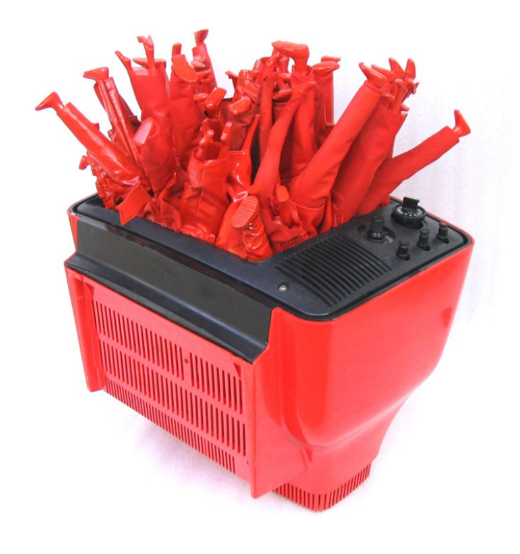
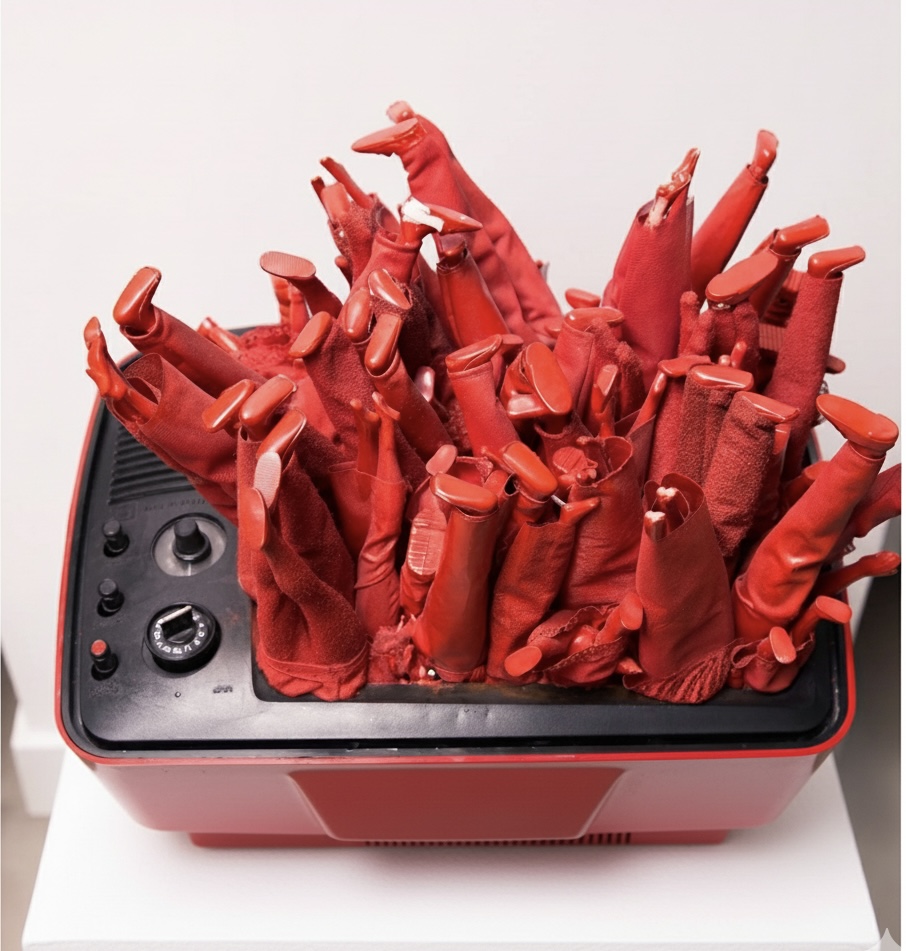
In this striking work entitled Red Dive, Kambiz Sabri turns a television set into a critical sculpture, transforming an everyday object into a violent metaphor for the image society. The screen, usually open to the world, here becomes the gaping maw of an abyss into which monochrome human silhouettes painted bright red plunge headlong. These miniature figures, absorbed by the camera, symbolize a humanity caught up in the hypnotic flow of the media and the frenetic consumption of images. Television, once a vector of information and collective bonding, is transformed into an instrument of alienation: a modern altar at which critical consciousness is sacrificed.
Sabri's choice of red reinforces the dramatic intensity of the scene: the color of danger, power and passion, it evokes seduction as much as destruction. The bodies, identical and devoid of individuality, seem reduced to puppets frozen in an infinite fall, a metaphor for a world where individuals become passive spectators, engulfed by the spectacle of their own powerlessness.
Expert opinion
Red Dive illustrates with remarkable symbolic force Kambiz Sabri's ability to create a dialogue between social criticism and pop aesthetics. The artist, trained in both sculpture and industrial design, exploits the materiality of a technological object to invert its function: the television no longer projects images, it absorbs them, and with them, its viewers. This visual and conceptual reversal reflects Sabri's lucidity in the face of a modernity saturated with communication but devoid of meaning.
The work also testifies to his fascination with the paradoxes of the contemporary world: the plastic beauty of the brilliant red contrasts with the implicit violence of the gesture. Behind its apparent irony, Red Dive highlights an existential concern, that of a humanity that, in its desire to be connected, loses itself in a void of images. Here, Sabri returns to the great questions of postmodern art: how do we represent a society in which technology shapes not only our gaze, but our very being? With this playfully critical sculpture, he erects a monument to the vertigo of media-driven modernity.
About the artist
Kambiz Sabri (b. 1967, Kashan, Iran) is an Iranian sculptor and visual artist whose practice explores the relationship between space, architecture and perception. Born in Kashan on April 18, 1967 and raised in Shahroud, he discovered drawing and painting at an early age at the Institute for the Intellectual Development of Children and Young Adults, where he received his first artistic training. Initially drawn to medicine, he moved to Tehran after failing the entrance exam, where his decisive meeting with architecture professor Abdolhossein Pazouki steered him towards design and creation. This period marked a decisive turning point in his artistic vocation, awakening in him a deep interest in sculpture and three-dimensional forms.
With a degree in Sculpture and Industrial Design (1996-2001) and a Master's in Graphic Design (2004-2007) from Tehran University's Faculty of Fine Arts, Sabri has developed a body of work combining conceptual rigor and formal freedom. His work has been presented at a number of prestigious international events, including the Venice Architecture Biennale (2016), the Sharjah Art Festival (2018-2019), the Florence Biennale of Contemporary Art (2013), as well as several editions of the Iranian Biennales of Contemporary Sculpture and Urban Space at the Museum of Contemporary Art in Tehran. He has also exhibited at Art Dubai, Art Paris, Taiss Gallery (Paris), ARTSPACE Gallery (London), and 1×1 Gallery (Dubai).
A multi-faceted artist, Kambiz Sabri questions the boundaries between art, design and urban planning. His sculptures, often monumental, reflect a fascination with structure and materiality, while integrating a poetic and critical dimension on modernity, memory and the transformation of public space. Through his career and his vision, he has established himself as one of the leading figures in contemporary Iranian sculpture, capable of linking the country's plastic tradition to an international dialogue on form and matter.
OTHER ARTWORKS YOU MAY LIKE
Your Dynamic Snippet will be displayed here...
This message is displayed because you did not provide both a filter and a template to use.