Victor Vasarely
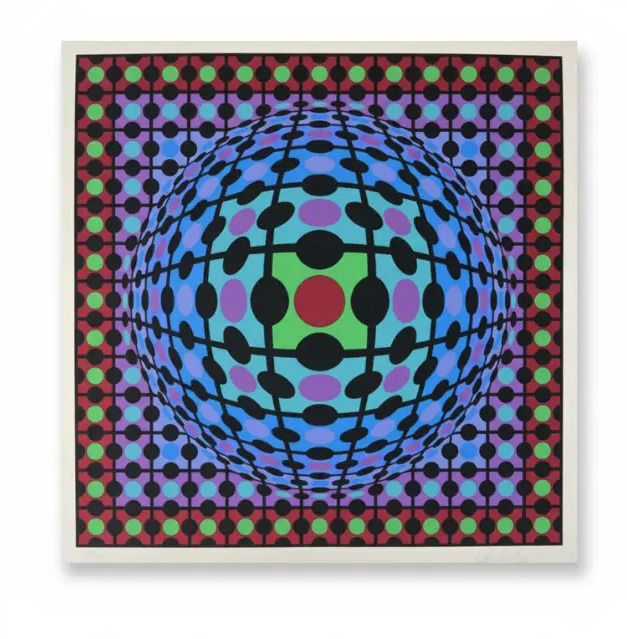
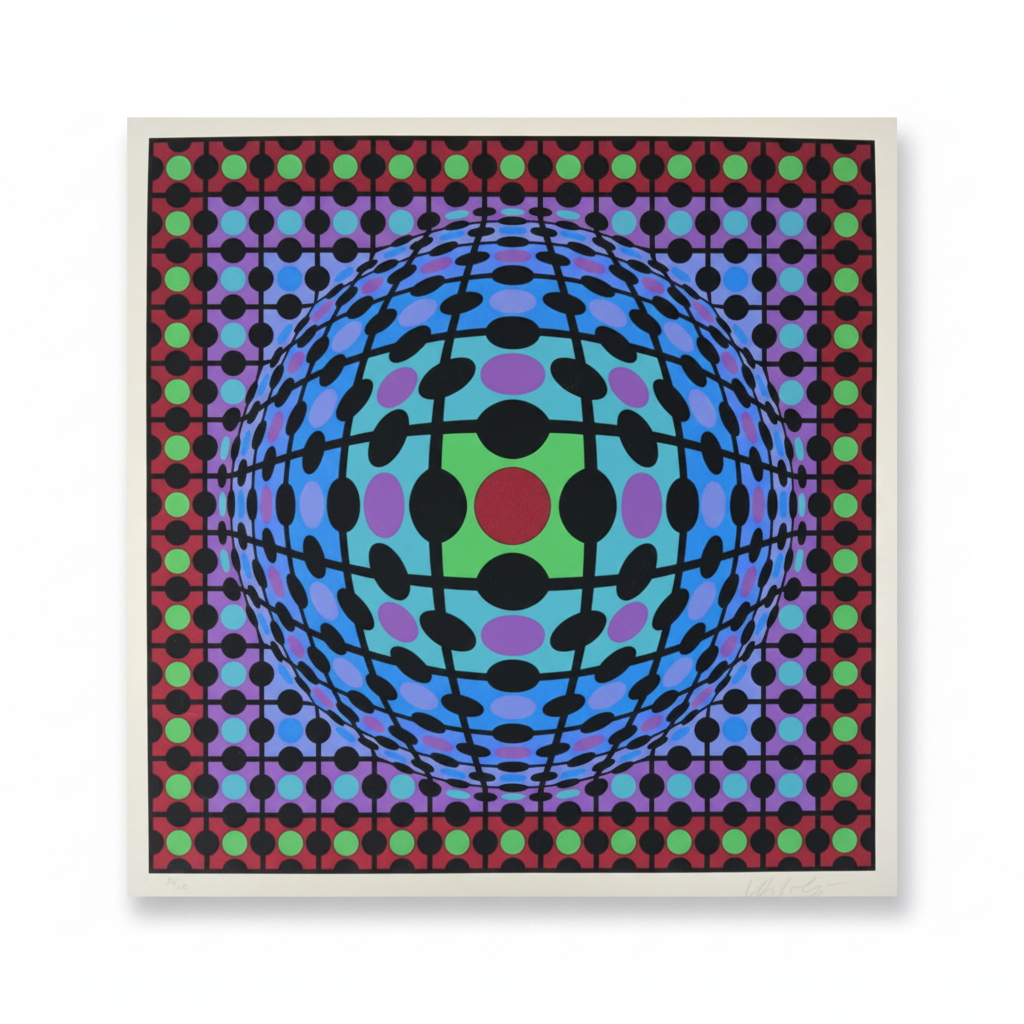
Procion-3
1977
Color silkscreen
75 × 70 cm
Ed. Artist’s Proof EA /15 (outside the main edition of 275)
Location: Paris, France
Documents
-
Invoice or proof of purchase
-
Certificate of authenticity
-
Other documents
About the artwork
Procion-3 is a striking example of Victor Vasarely’s pioneering contributions to Op Art, showcasing his mastery of geometric abstraction and optical vibration. Composed of a dense grid of colorful circular forms and a central spherical structure that appears to bulge outward, the work creates the illusion of movement and three-dimensionality. Vasarely’s expert manipulation of color, alternating blues, greens, reds, and purples, produces a dynamic visual rhythm that engages the viewer’s perception. Hand-signed by the artist and published by Georges Fall, this Artist’s Proof (EA) is part of a scarce group of 15 impressions, making it more exclusive than the standard edition of 275. The print exemplifies Vasarely’s mature period, where optical experimentation and chromatic precision reached their peak.
Expert opinion
As an Artist’s Proof from a very small group of 15 impressions, Procion-3 holds enhanced desirability on the market compared to the regular edition. Works from Vasarely’s 1970s period, particularly those featuring strong spherical illusions, are among the most sought after by collectors because they embody the core principles of Op Art with exceptional clarity. The vibrant palette, combined with Vasarely’s precise geometrical construction, reflects a moment when his chromatic theories and optical effects were fully developed. Artist’s Proofs (EAs) traditionally command higher interest due to their rarity and their close association with the artist’s hand. In excellent condition, such prints routinely achieve strong results at auction and remain stable investments within the Op Art market.
About the artist
Victor Vasarely (1906-1997) was a Hungarian artist who in 1929 joined the Muhëly School in Budapest, recognized as the equivalent of the German Bauhaus school. He was profoundly influenced by the school's teaching, which introduced him to Constructivist trends and Abstract Art. Quickly bored by abstraction, he sought to "excite the eye" and depict active forms, focusing on both form and perception. In the 1950s, he participated in the creation of the first optical works of kinetic art, with productions that were initially black and white. In the same vein, he distinguished himself in contemporary art by creating a new trend: optical art. While Vasarely achieved notoriety during his lifetime, his work was omnipresent in France from the 60s and 70s onwards. He was as much the creator of the Renault logo as he was of a David Bowie album cover and several Parisian building decors. His work is included in the permanent collections of major museums such as the Centre Georges Pompidou (Paris) and the Museum of Modern Art (San Francisco). Before his death, with the help of his wife, Victor Vasarely established the Vasarely Foundation in Aix-en-Provence, where some of his works have since been conserved.
Additional info
Signed
3x
OTHER ARTWORKS YOU MAY LIKE
Your Dynamic Snippet will be displayed here...
This message is displayed because you did not provide both a filter and a template to use.