Juan Gris
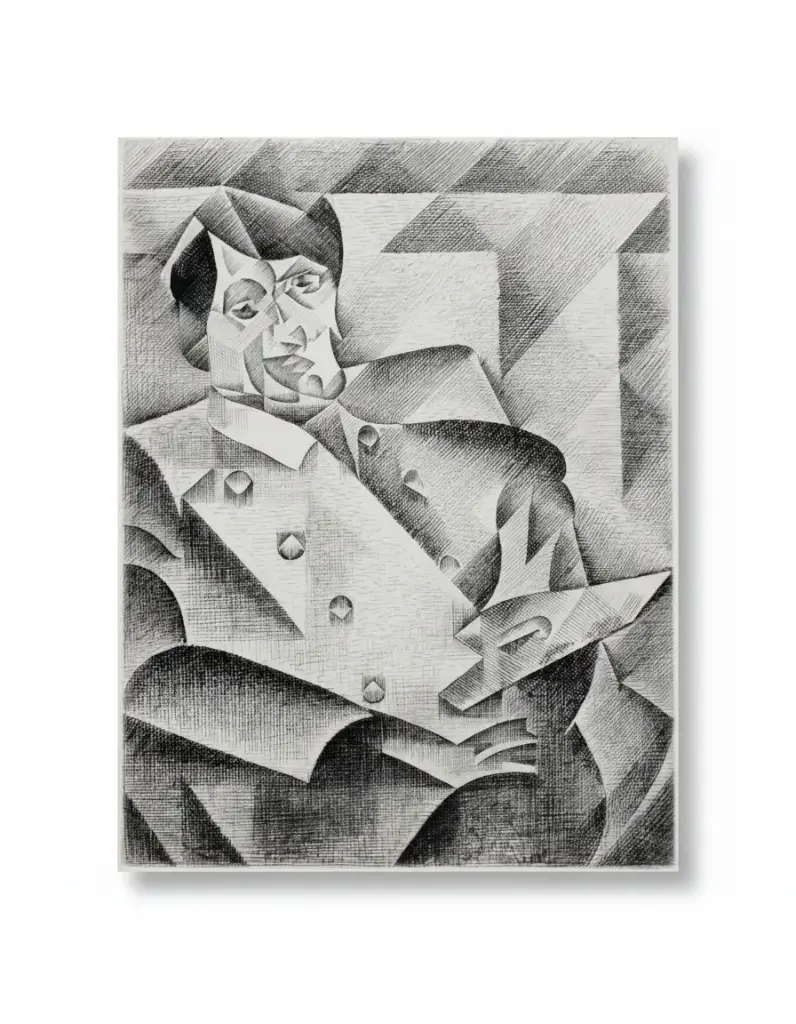
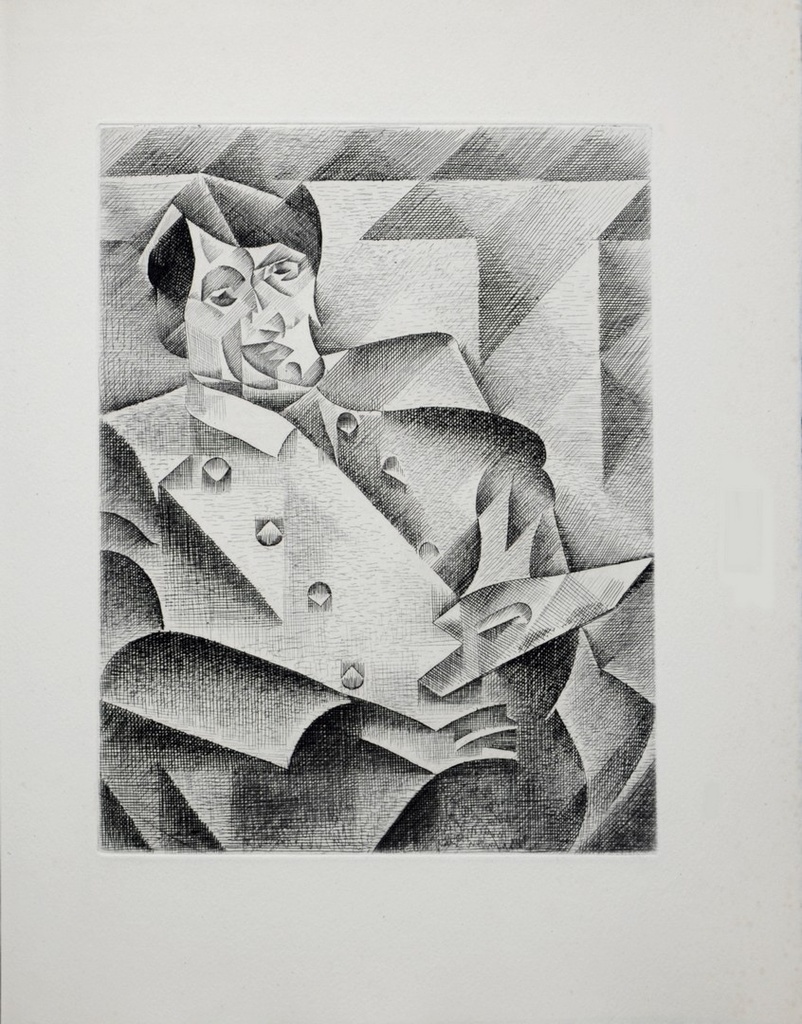
Portrait de Picasso
1947
Etching and drypoint on Lana pure-fibre paper
18 × 13.8 cm
Ed. /455

Arianee token ID
854352064
Share by
Email
Documents
-
Invoice or proof of purchase
-
Certificate of authenticity
-
Other documents
About the artwork
Rendered through densely hatched linear networks, the composition presents a seated male figure constructed from fragmented, angular planes. The head is faceted into distinct geometric polygons, while the torso and jacket dissolve into alternating zones of parallel engraving lines that define volume and light without relying on conventional tonal modeling. Published posthumously in 1947 as part of the portfolio *Du Cubisme*, the plate serves as a visual document reflecting the aesthetic principles formulated during the height of the cubist movement.
Expert opinion
As an item originating from a post-war commemorative portfolio, the sheet illustrates the institutional dissemination of early modernist history in France during the late 1940s. The piece holds educational and documentary value for collections focusing on graphic techniques and twentieth-century print portfolios.
About the artist
José Victoriano González-Pérez, known as Juan Gris, was a Spanish painter and sculptor born in Madrid in 1887 who spent the majority of his working life in France. Associated closely with the origins of Cubism, he developed a rigorous, highly structured approach to the movement that emphasized mathematical precision and harmonic composition. Living in Paris from 1906 onward, he maintained close associations with key avant-garde figures at the Bateau-Lavoir. His mature output is defined by synthetic cubist idioms, where objects are constructed through overlapping planes, translucent color geometries, and a calculated interplay of shadow and light. Unlike many contemporaries, he frequently incorporated everyday still-life elements with architectural grid systems, establishing a distinct visual lexicon. His career was cut short by his death in Boulogne-sur-Seine in 1927, leaving behind a body of work held in major international museum collections.
Additional info
3x
OTHER ARTWORKS YOU MAY LIKE
Your Dynamic Snippet will be displayed here...
This message is displayed because you did not provide both a filter and a template to use.