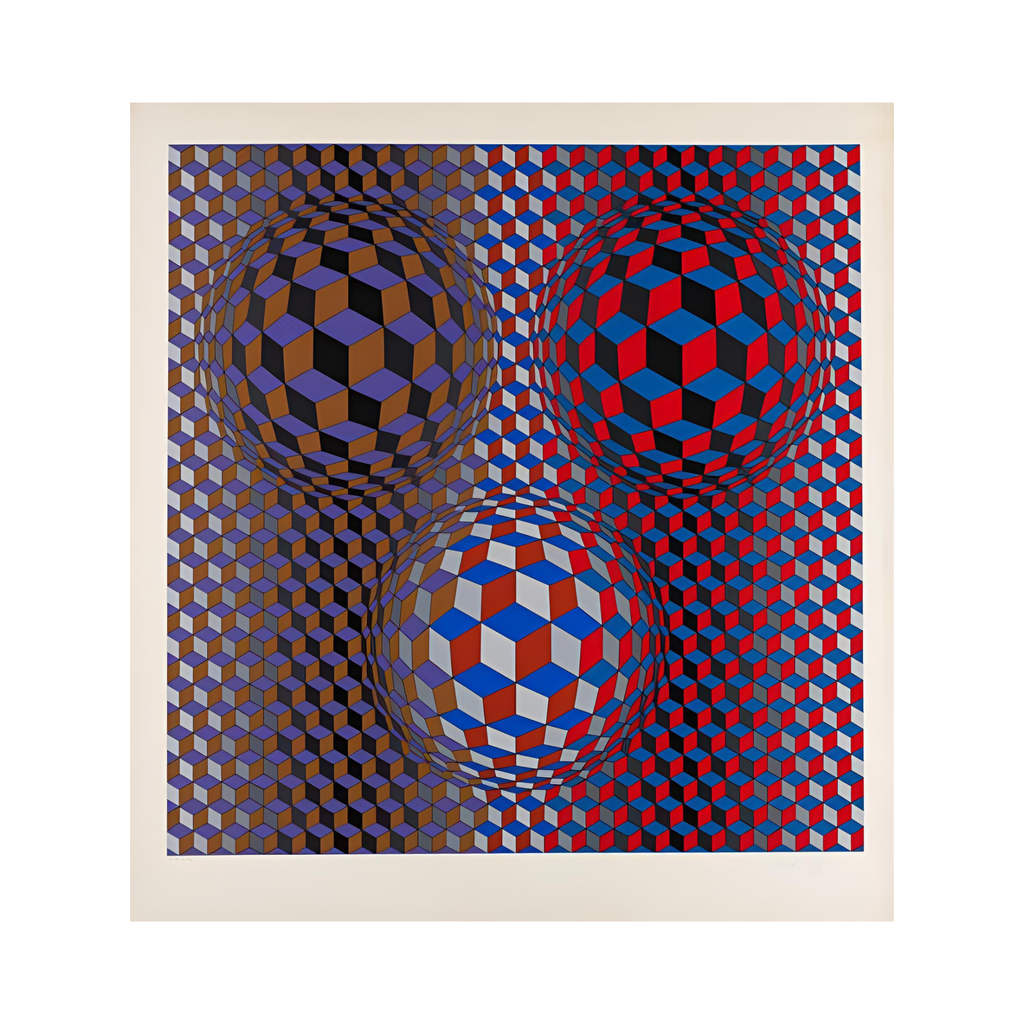
Victor Vasarely
Conjonction
1987
Color silkscreen
82 × 78 cm
Ed. /20
Location: Paris, France
Documents
-
Invoice or proof of purchase
-
Certificate of authenticity
-
Other documents
About the artwork
Conjonction (1987) stands as a refined illustration of Victor Vasarely’s lifelong exploration of optical perception and spatial ambiguity. In this composition, three spherical volumes appear to hover simultaneously in front of and behind a densely patterned field of interlocking cubes. The surface is alive with visual tension: the vibratory interplay of red, blue, violet, and brown tones creates a perceptual instability that shifts as the viewer moves across the image. This deliberate optical disturbance, an essential component of Vasarely’s language, causes the spheres to pulsate, expand, or contract in space. The technical precision of this silkscreen is remarkable. Each chromatic transition has been calibrated to maximize the illusion of depth without relying on traditional modeling. Instead, Vasarely draws upon the capacity of pure geometric forms and mathematical rhythm to evoke movement. Produced in an exceptionally small edition of only 20, all hand-signed, this work is considerably rarer than the artist’s more widely circulated prints. Its inclusion in the Benavides catalogue (no. 1028) further attests to its importance within the documented body of Vasarely’s mature output.
Expert opinion
Conjonction is a highly desirable work within Vasarely’s editioned output and demonstrates a level of chromatic and structural complexity typically associated with his major museum pieces. Works from this period, the late 1980s, reflect the culmination of decades of research into optical systems, years during which Vasarely refined the visual grammar that made him one of the founders of Op Art. The rarity of the edition alone sets this print apart: an edition of only 20 is exceptionally small for Vasarely, whose works were often produced in significantly larger print runs for public dissemination. This limited quantity increases both scarcity and value, appealing to experienced collectors who prioritize exclusivity and early acquisition opportunities. Furthermore, compositions featuring multiple spheres in dynamic tension are especially prized. These works encapsulate Vasarely’s most iconic investigations into the perception of movement, three-dimensional illusion, and the instability of visual space. The technical precision of this silkscreen also speaks to the artist’s collaboration with highly skilled printers, ensuring that the piece remains faithful to his chromatic intentions. Its documented reference (Benavides 1028) strengthens its position in the market, reassuring collectors of its authenticity, provenance, and relevance within the established scholarship on Vasarely.
About the artist
Victor Vasarely (1906-1997) was a Hungarian artist who in 1929 joined the Muhëly School in Budapest, recognized as the equivalent of the German Bauhaus school. He was profoundly influenced by the school's teaching, which introduced him to Constructivist trends and Abstract Art. Quickly bored by abstraction, he sought to "excite the eye" and depict active forms, focusing on both form and perception. In the 1950s, he participated in the creation of the first optical works of kinetic art, with productions that were initially black and white. In the same vein, he distinguished himself in contemporary art by creating a new trend: optical art. While Vasarely achieved notoriety during his lifetime, his work was omnipresent in France from the 60s and 70s onwards. He was as much the creator of the Renault logo as he was of a David Bowie album cover and several Parisian building decors. His work is included in the permanent collections of major museums such as the Centre Georges Pompidou (Paris) and the Museum of Modern Art (San Francisco). Before his death, with the help of his wife, Victor Vasarely established the Vasarely Foundation in Aix-en-Provence, where some of his works have since been conserved.
Additional info
Signed
3x
OTHER ARTWORKS YOU MAY LIKE
Your Dynamic Snippet will be displayed here...
This message is displayed because you did not provide both a filter and a template to use.