

Josef Albers
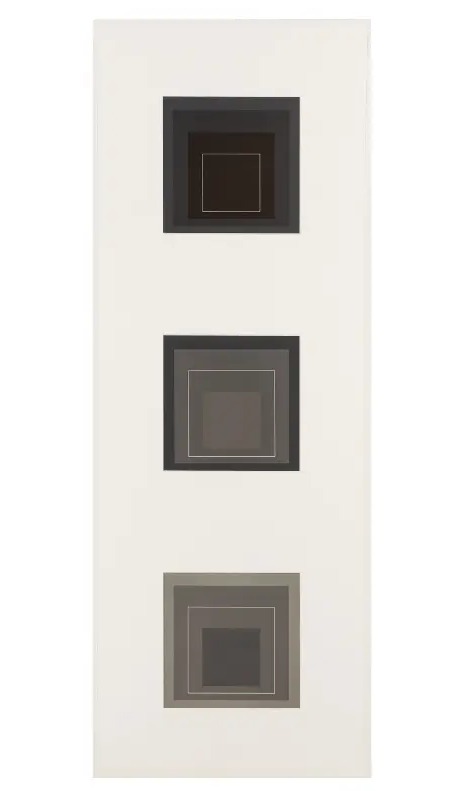
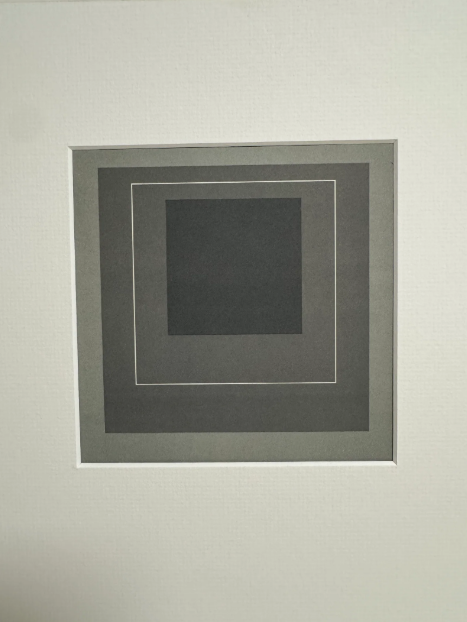
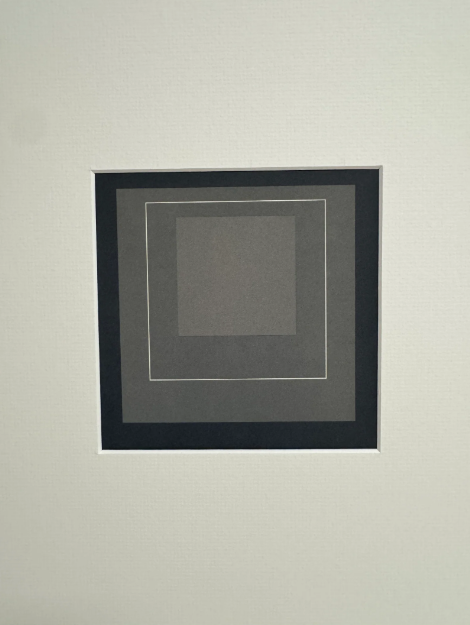
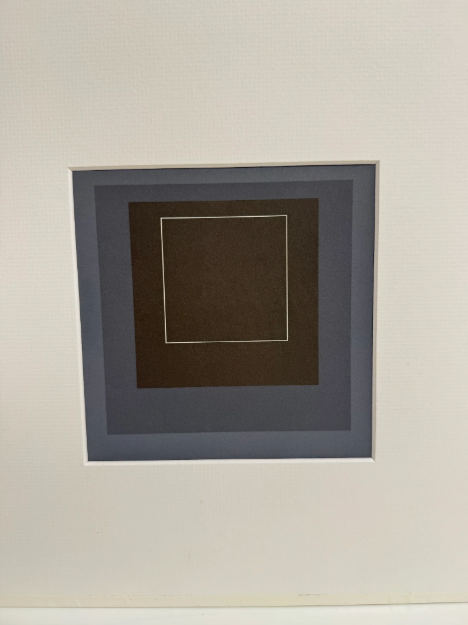
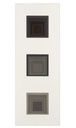
White Line Squares Triptych
1983
Three bookplates printed using offset lithography on vellum paper
14 × 14 × 2 cm
Complete set of three
Location: Paris, France

Arianee token ID
669506277
Share by
Email
Documents
-
Invoice or proof of purchase
-
Certificate of authenticity
-
Other documents
About the artwork
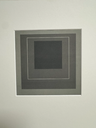
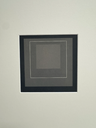
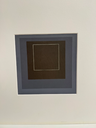
Démonstration éloquente de la fascination durable de Josef Albers pour l'interaction des couleurs et la précision géométrique,ce triptyque présente trois compositions distinctes de carrés imbriqués. Chaque panneau,un ex-libris,comporte un carré central entouré de carrés progressivement plus grands,tous rendus avec une ligne blanche nette définissant leurs bords sur des champs de gris tonals et de quasi-noirs variés. Les subtils décalages de teinte et de valeur au sein de chaque carré créent une illusion optique de profondeur et de récession,invitant le spectateur à observer comment la perception de chaque couleur est altérée par ses voisines.
L'arrangement systématique et la palette limitée de cette œuvre sont des caractéristiques de la série « Hommage au Carré » d'Albers,même dans cette interprétation ultérieure. Le panneau supérieur présente des tons plus foncés et plus saturés,tandis que les panneaux du milieu et du bas passent à des gris plus clairs et plus sourds,créant un dégradé vertical à travers le triptyque. Cette modulation soignée de la couleur et de la lumière,malgré les formes géométriques apparemment simples,révèle la profonde compréhension de la théorie des couleurs par l'artiste et sa capacité à évoquer des expériences visuelles complexes à partir de moyens minimaux.
Expert opinion
Although produced posthumously, this work embodies the fundamental principles of Josef Albers’ seminal series “Homage to the Square,” making it a significant educational and aesthetic piece. It offers a clear example of his lifelong dedication to exploring the relativity of color perception and the power of geometric abstraction. For collectors, it represents an accessible entry point into the legacy of a founding figure of 20th-century art, whose influence on Minimalism and Op Art is undeniable. As an investment, Albers’s works retain a stable value, with posthumous prints and bookplates generally appreciating steadily, particularly when they are part of a complete and well-preserved collection.
About the artist
Josef Albers (1888–1976) was a German-born American artist and educator whose career spanned from the Bauhaus in Germany to Black Mountain College and Yale University in the United States. He first trained as a teacher, then studied art in Berlin, Essen, and Munich before enrolling at the Bauhaus in Weimar in 1920. At the Bauhaus, he became a master in 1925, teaching introductory courses and working in the glass studio. After the Bauhaus closed in 1933, Albers emigrated to the United States, where he joined the faculty at Black Mountain College in North Carolina. There, he established an art program and taught until 1949, mentoring artists such as Robert Rauschenberg and Cy Twombly. In 1950, he was appointed head of the design department at Yale University, where he continued to develop his theories on color and perception. His best-known work is the “Homage to the Square” series, which he began in 1950 and continued until his death.
Additional info
3x
OTHER ARTWORKS YOU MAY LIKE
Your Dynamic Snippet will be displayed here...
This message is displayed because you did not provide both a filter and a template to use.