Francis Bacon
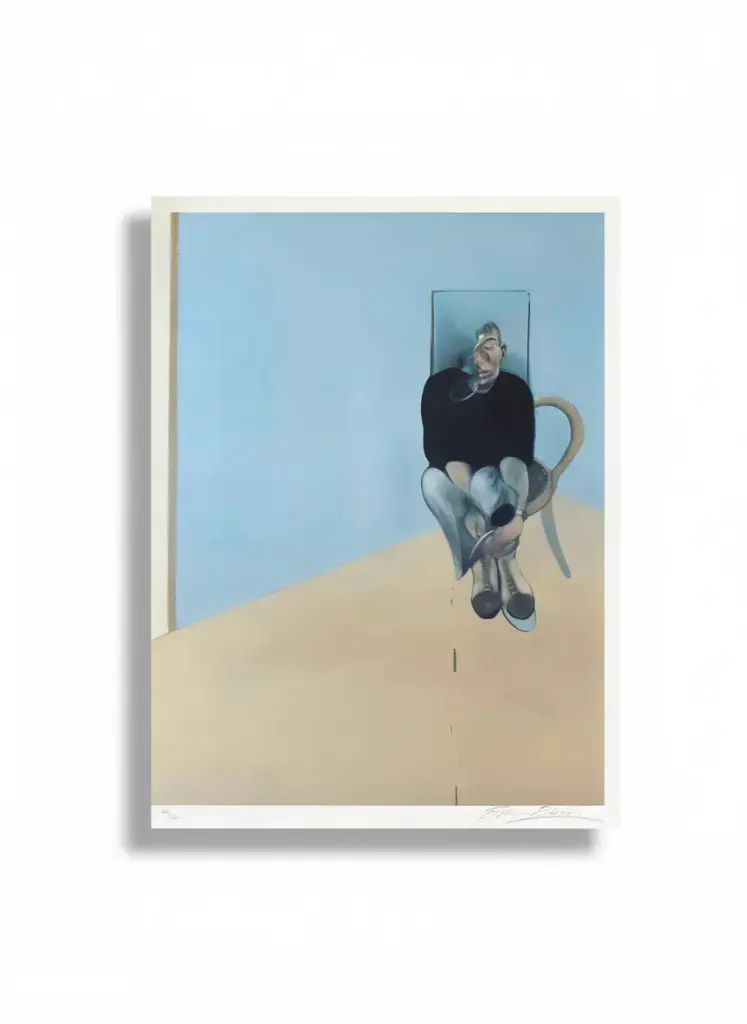
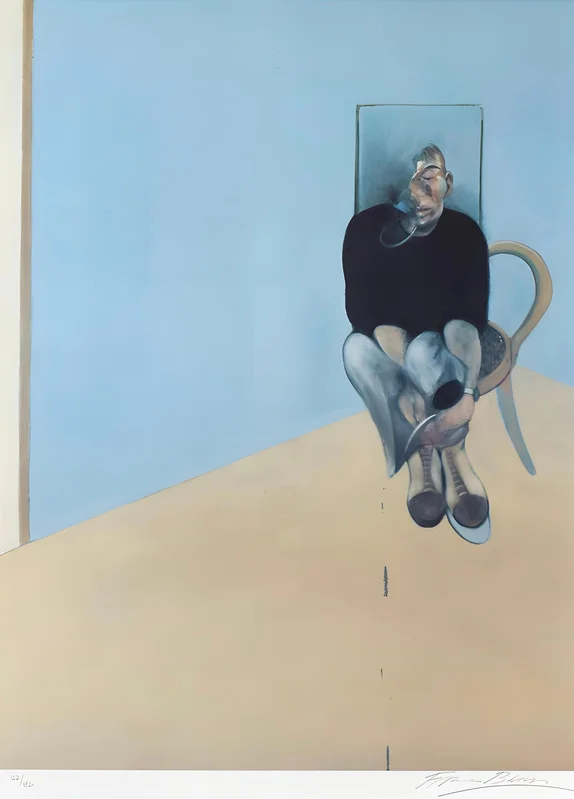
Study for Self-Portrait
1984
Offset lithograph in colours on wove paper
80 × 61 cm
Ed. /182 + AP — Publisher: Marlborough Gallery, New York
Location: Pairs, France

Arianee token ID
925848504
Share by
Email
Documents
-
Invoice or proof of purchase
-
Certificate of authenticity
-
Other documents
About the artwork
Published by Marlborough Gallery in New York, the composition presents a solitary figure seated upon a curved chair within a sparse room defined by a sharp diagonal floor plane and a uniform blue backdrop. The subject's torso is clad in a dark sweater, while the head undergoes a characteristic dissolution, with facial traits smeared and blurred as if caught in motion or subjected to psychological pressure. Executed as a large-format offset lithograph, the piece translates the painterly concerns of the artist's canvas works into the graphic medium. The vertical framing device behind the sitter echoes the recurring spatial enclosures typical of the creator's visual vocabulary, isolating the figure against an undefined, atmospheric void.
Expert opinion
This graphic edition occupies an established position within the artist's printed oeuvre, which was catalogued comprehensively by Bruno Sabatier under reference number 35. While the primary market for Bacon remains dominated by unique paintings, his limited edition prints authorized during his lifetime provide insight into his engagement with reproductive media under strict supervision.
About the artist
Francis Bacon (1909-1992) is one of the major figures of 20thᵉ century art, renowned for his powerful, brutal and deeply psychological paintings. Born in Dublin into an Anglo-Irish family, he spent his childhood between Ireland and England before leaving home in his teens. Largely self-taught, Bacon began painting in the 1930s, but it wasn't until the late 1940s that he truly established himself on the art scene, notably with his emblematic series inspired by Velázquez's Crying Pope. His work is marked by expressive, distorted representations of the human figure, reflecting an obsession with the vulnerability of the body and the intensity of existence. Bacon draws on a vast repertoire of images - photography, cinema, medicine, classical art - to create compositions that combine violence, sensuality and tragic modernity. His style is characterized by vibrant colors, architectural backgrounds and energetic pictorial gestures. Settling in London, he frequented post-war intellectual and artistic circles, finding in these exchanges fertile ground for his artistic development. His tumultuous relationship with George Dyer, muse, lover and central subject of many of his works, played a decisive role in his creative output in the 1960s and 1970s. Bacon achieved international recognition during his lifetime, with major exhibitions at the Tate Gallery, the Grand Palais, MoMA and many other leading institutions. After his death in 1992, his London studio was reconstructed piece by piece at Dublin City Gallery The Hugh Lane, offering a unique insight into his creative process. Today, Francis Bacon remains one of the most influential and studied artists of the XXᵉ century, celebrated for his ability to probe the human soul through visceral, unforgettable painting.
Additional info
Signed
3x
OTHER ARTWORKS YOU MAY LIKE
Your Dynamic Snippet will be displayed here...
This message is displayed because you did not provide both a filter and a template to use.