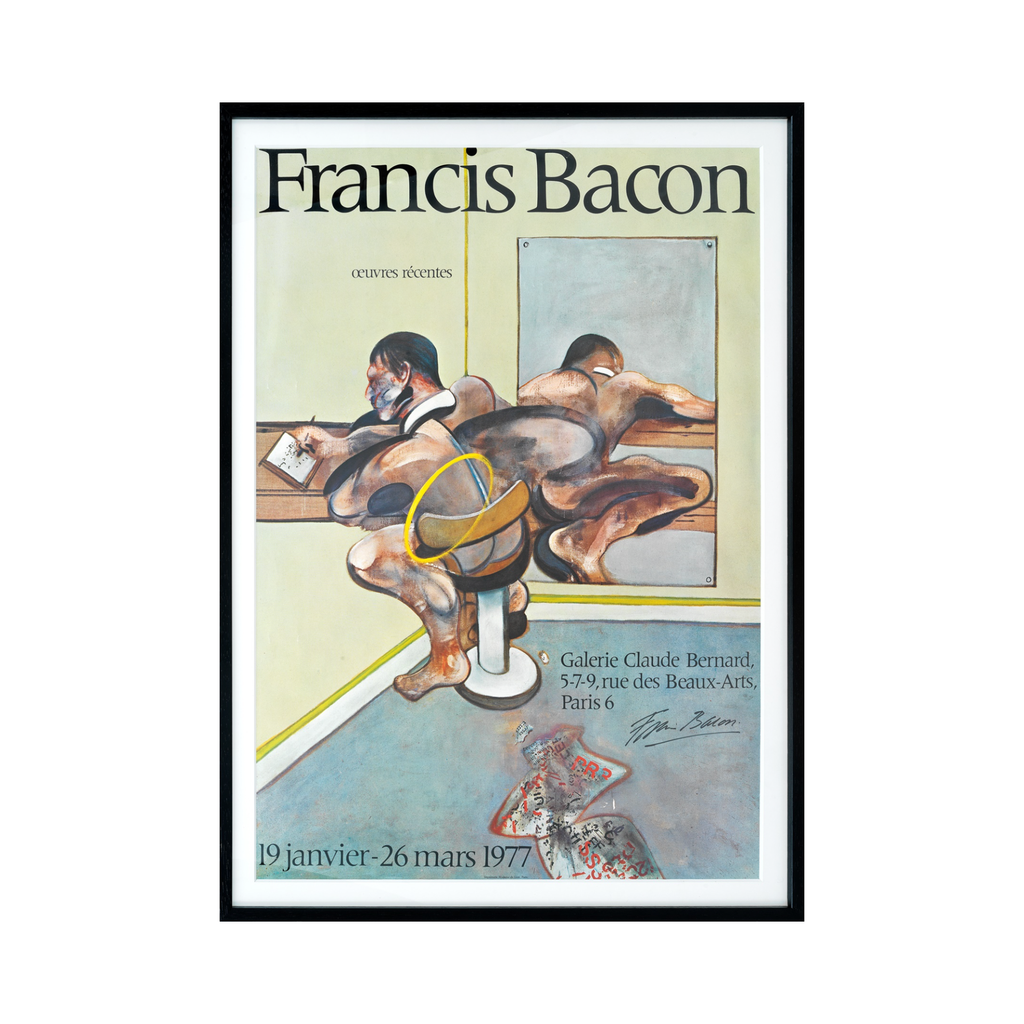
Francis Bacon
Exhibition Poster – Galerie Claude Bernard
1977
71 × 51 cm
Exhibition posters were produced in limited quantities for promotional purposes.
Location: Paris, France
Documents
-
Invoice or proof of purchase
-
Certificate of authenticity
-
Other documents
About the artwork
Produced in 1977 to coincide with Francis Bacon's exhibition at the Galerie Claude Bernard in Paris, this autographed poster bears direct witness to the relationship between the artist and the French art scene of the late 1970s. Measuring 71 x 51 cm, it features an image emblematic of Bacon's pictorial language, characterized by a distorted, contorted figure set in an interior space structured by clean architectural lines and subtly modulated flat tones of color. The tension between the distorted flesh and the geometric environment reinforces the sense of confinement and psychological instability that runs through all his work. The artist's name, inscribed at the top in a sober, elegant typography, dialogues with the exhibition information, anchoring the image in its precise historical context. The signature on the poster adds an extra dimension to this promotional object, transforming a period document into a collector's item in its own right.
Expert opinion
This signed exhibition poster is of particular interest because of its hybrid status, at the crossroads of historical document and art object. Posters produced for Francis Bacon's exhibitions were published in limited quantities for promotional purposes, and few signed copies remain on the market today. The period of the late seventies corresponds to a moment of full maturity in Bacon's career, marked by international institutional recognition and an intensification of his research into the representation of the body and inner violence. The autograph signature reinforces the work's heritage value by establishing a direct link with the artist. For collectors and institutions interested in the history of exhibitions and the dissemination of Bacon's work in France, this poster is an invaluable historical, aesthetic and documentary testimony.
About the artist
Francis Bacon (1909-1992) is one of the major figures of 20thᵉ century art, renowned for his powerful, brutal and deeply psychological paintings. Born in Dublin into an Anglo-Irish family, he spent his childhood between Ireland and England before leaving home in his teens. Largely self-taught, Bacon began painting in the 1930s, but it wasn't until the late 1940s that he truly established himself on the art scene, notably with his emblematic series inspired by Velázquez's Crying Pope. His work is marked by expressive, distorted representations of the human figure, reflecting an obsession with the vulnerability of the body and the intensity of existence. Bacon draws on a vast repertoire of images - photography, cinema, medicine, classical art - to create compositions that combine violence, sensuality and tragic modernity. His style is characterized by vibrant colors, architectural backgrounds and energetic pictorial gestures. Settling in London, he frequented post-war intellectual and artistic circles, finding in these exchanges fertile ground for his artistic development. His tumultuous relationship with George Dyer, muse, lover and central subject of many of his works, played a decisive role in his creative output in the 1960s and 1970s. Bacon achieved international recognition during his lifetime, with major exhibitions at the Tate Gallery, the Grand Palais, MoMA and many other leading institutions. After his death in 1992, his London studio was reconstructed piece by piece at Dublin City Gallery The Hugh Lane, offering a unique insight into his creative process. Today, Francis Bacon remains one of the most influential and studied artists of the XXᵉ century, celebrated for his ability to probe the human soul through visceral, unforgettable painting.
Additional info
Signed
3x
OTHER ARTWORKS YOU MAY LIKE
Your Dynamic Snippet will be displayed here...
This message is displayed because you did not provide both a filter and a template to use.