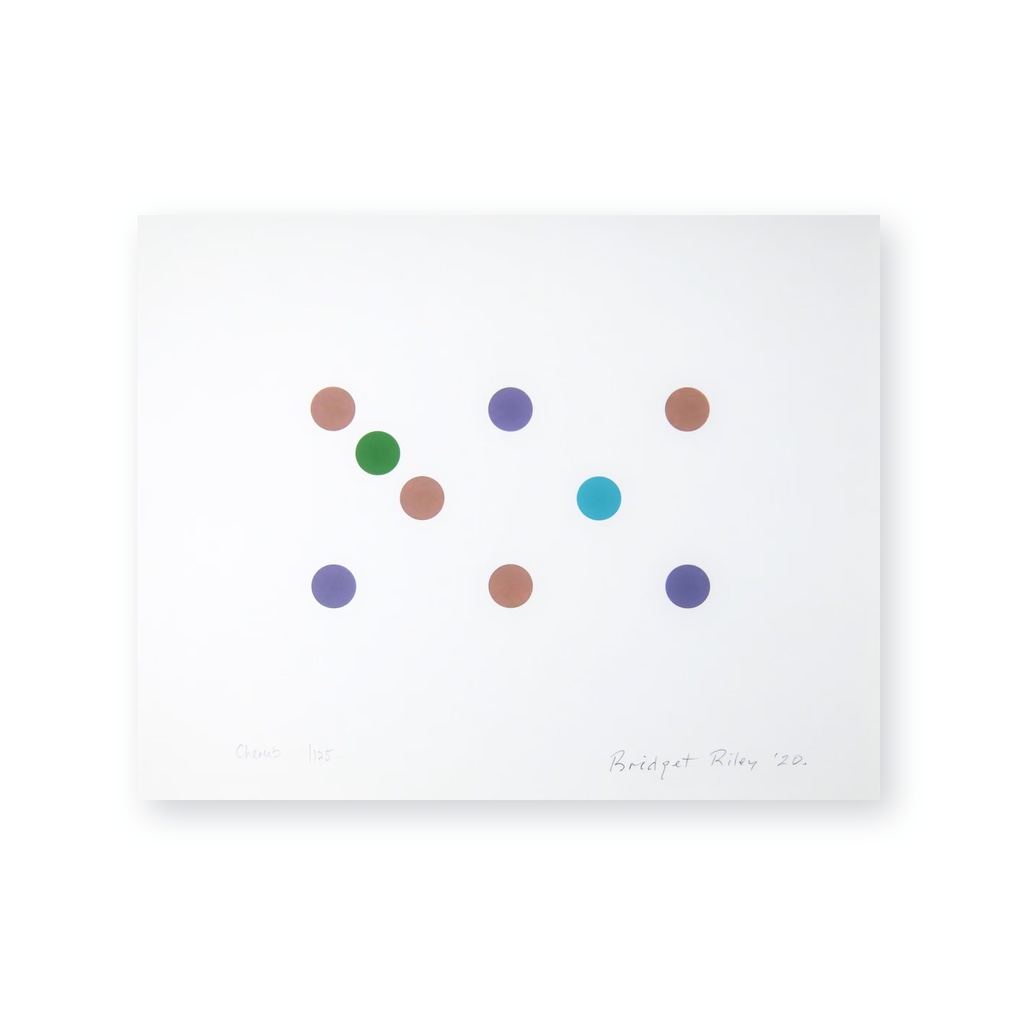
Bridget Riley
Cherub
2020
Screenprint in colours on paper
40 × 50 cm
Ed. / 125 — Signed and numbered
Location: London, United Kingdom

Arianee token ID
923856799
Share by
Email
Documents
-
Invoice or proof of purchase
-
Certificate of authenticity
-
Other documents
About the artwork
Produced in 2020,Cherub consists of a horizontal sequence of narrow colored bands extending across a white ground. Pale and saturated tones are placed in close relation,creating a sensation of light and visual ascent. The image is precisely printed and non-representational,with its movement arising from the accumulation and spacing of color rather than from depicted forms.
The stated technique is screenprint in colors on paper. It measures approximately 40 × 50 cm. The screenprinting process produces clean edges and consistent fields of color across the white paper. Because the composition contains no modeled objects or descriptive background,small changes in width,spacing and chromatic sequence become the principal visual events.
Expert opinion
Cherub reflects Riley’s mature shift from high-contrast optical structures toward increasingly nuanced color relationships. Its horizontal progression creates a sensation of lift that helps explain the light,aerial title. The work is quiet in appearance but highly active perceptually,rewarding sustained rather than immediate viewing.
As a work by Bridget Riley,Cherub is notable because it treats color as an event created between adjacent elements rather than a descriptive property.
About the artist
Bridget Riley (born 1931 in London, England) is one of the most influential British artists of the post-war period and a pioneering figure associated with Op Art. For more than six decades, her practice has explored the fundamental relationship between colour, form, rhythm and human perception, creating compositions that appear to vibrate, shift and move before the viewer's eyes.
Riley studied at Goldsmiths College in London from 1949 to 1952, followed by the Royal College of Art, where she continued her training during the 1950s. Her early work was figurative, but by the beginning of the 1960s she had developed the abstract visual language that would establish her international reputation.
Her first celebrated works were rigorous black-and-white paintings composed of geometric elements such as lines, circles, curves and squares. Through repetition and carefully calculated variations, Riley created powerful optical effects in which apparently static surfaces seem to pulse, ripple or shift. Her first solo exhibitions took place at Gallery One in London in 1962 and 1963.
Riley gained major international recognition during the 1960s and became closely associated with the development of Op Art. In 1967 she introduced colour into her work, opening up an increasingly sophisticated investigation of how adjacent colours interact. Rather than using colour simply descriptively, Riley treats it as an active element capable of producing sensations of light, space, rhythm and movement.
Stripes became particularly important within her practice. By modifying their width, sequence, density and colour relationships, Riley discovered that seemingly simple arrangements could generate remarkably complex perceptual experiences. Her later works have continued to explore stripes alongside curves, diagonals and other geometric structures, both in paintings and in monumental wall compositions.
Riley's work is rooted in a sustained investigation of how we see. Although her compositions are constructed according to precise formal systems, their purpose is fundamentally experiential: movement and instability are produced not physically within the artwork but through the viewer's own perception. This tension between mathematical structure and sensory experience has remained central throughout her career.
Her contribution to contemporary art has been recognised with numerous major distinctions. Riley was appointed CBE in 1974 and Companion of Honour in 1999. She received Japan's Praemium Imperiale in 2003, the Kaiserring of Goslar in 2009 and the Rubens Prize of the City of Siegen in 2012.
Her work has been exhibited internationally and is held in major museum collections including Tate, The Museum of Modern Art and The Metropolitan Museum of Art in New York, the Art Institute of Chicago, Los Angeles County Museum of Art, Moderna Museet in Stockholm and the National Museum of Modern Art in Tokyo. Riley lives and works between London, Cornwall and France.
Additional info
3x
OTHER ARTWORKS YOU MAY LIKE
Your Dynamic Snippet will be displayed here...
This message is displayed because you did not provide both a filter and a template to use.