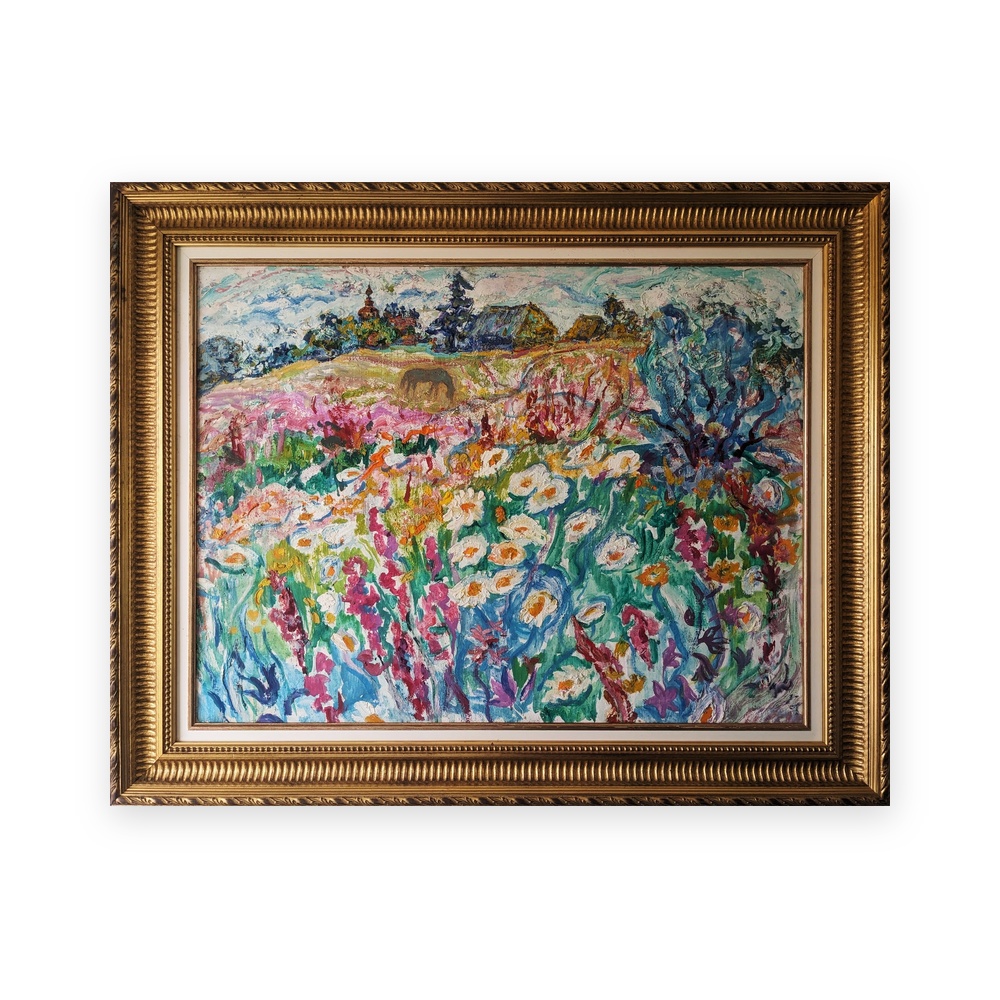
Nina Lugovskaya
Landscape study
1980
Oil on board
60 × 70 cm
Unique
Localisation : Royaume-Uni

Arianee token ID
919231253
Share by
Email
Documents
-
Invoice or proof of purchase
-
Certificate of authenticity
-
Other documents
À propos de l'œuvre
Thickly applied impasto builds a vibrant meadow foreground filled with abstracted floral forms in white,yellow,and magenta,set against a rolling countryside under an expressive sky. In the mid-ground,a solitary dark grazing animal and rural cottages punctuate the pastoral expanse,while dense patches of deep blue foliage anchor the composition on the right. The application of paint relies on visible,energetic brushstrokes and a high-keyed palette characteristic of mid-century plein-air studies from the Russian provinces.
Created during the post-Stalinist period when many artists returned to direct observation of nature,this piece reflects the stylistic liberation experienced by former Gulag survivors permitted to resume creative work. The iconography draws directly from the rural surroundings of Vladimir,emphasizing atmospheric light and chromatic intensity over strict academic realism. The tactile surface quality and raw handling of medium underscore an approach focused on immediate chromatic sensation.
Avis de l'expert
This composition exemplifies the stylistic tenets of the Vladimir School,characterized by heavy impasto,bright palettes,and an emphasis on local rural scenery. Within the broader framework of twentieth-century Russian art,works from this period represent a subtle departure from sanctioned Socialist Realism toward a more personal,impressionistically inclined interpretation of landscape.
À propos de l'artiste
Nina Sergueïevna Lugovskaïa était une peintre et scénographe soviétique. Née à Moscou en 1918, sa jeunesse a été bouleversée par l’arrestation de son père lors des purges politiques ; elle a par la suite acquis une grande notoriété à titre posthume en tant qu’auteure d’un journal intime d’adolescente confisqué, découvert dans les archives du KGB. Après sa libération d’un camp de travail de Kolyma et son exil en Sibérie, elle a étudié à l’École d’art de Serpukhov et a travaillé comme scénographe dans diverses salles régionales.
S’étant installée à Vladimir avec son mari et collègue artiste Viktor Templin, elle a développé sa pratique picturale au sein des cercles artistiques liés à l’École de peinture paysagiste de Vladimir. Elle a adhéré à l’Union des artistes de l’URSS en 1977 et a participé à des expositions officielles tout au long des années 1970 et 1980. Ses œuvres sont conservées dans plusieurs musées régionaux russes, et son identité artistique reste étroitement liée au dégel post-stalinien et aux traditions figuratives expressives du modernisme soviétique provincial.
Informations complémentaires
3x
D'AUTRES OEUVRES SUR ARTRANSFER
Your Dynamic Snippet will be displayed here...
This message is displayed because you did not provide both a filter and a template to use.