
À propos de l'œuvre
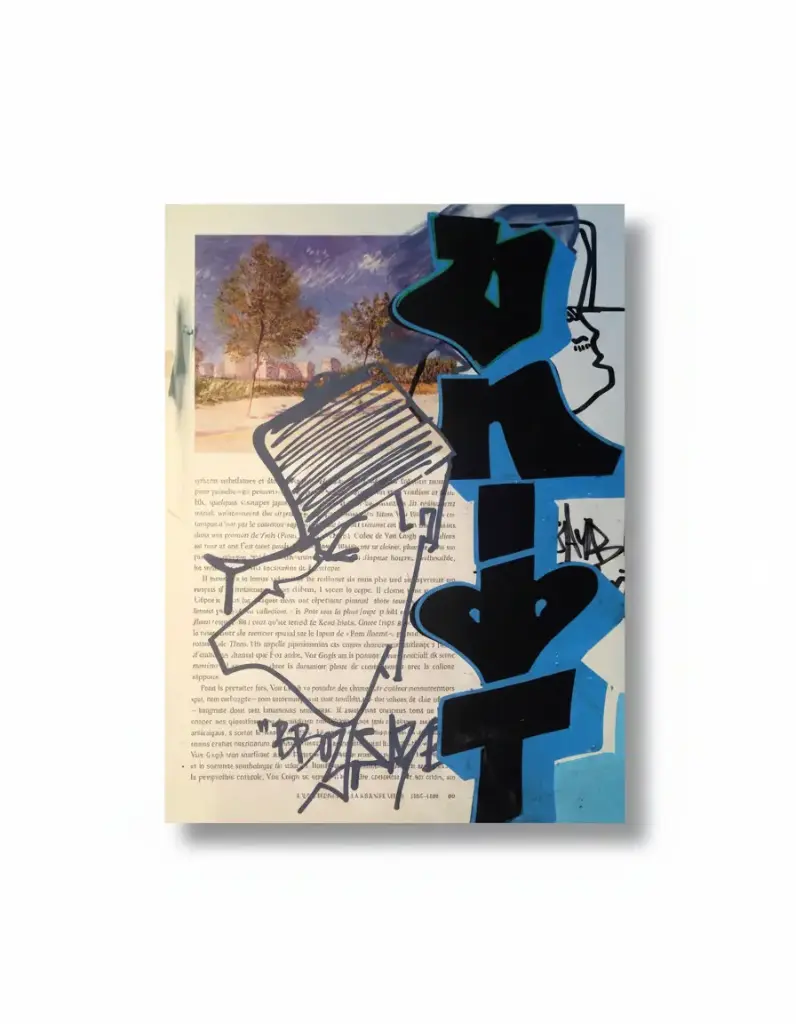
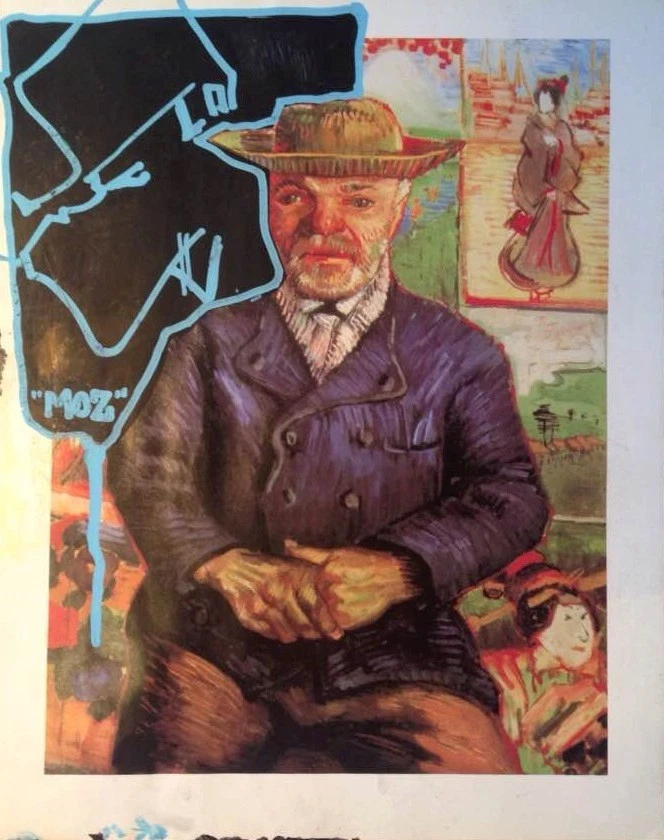
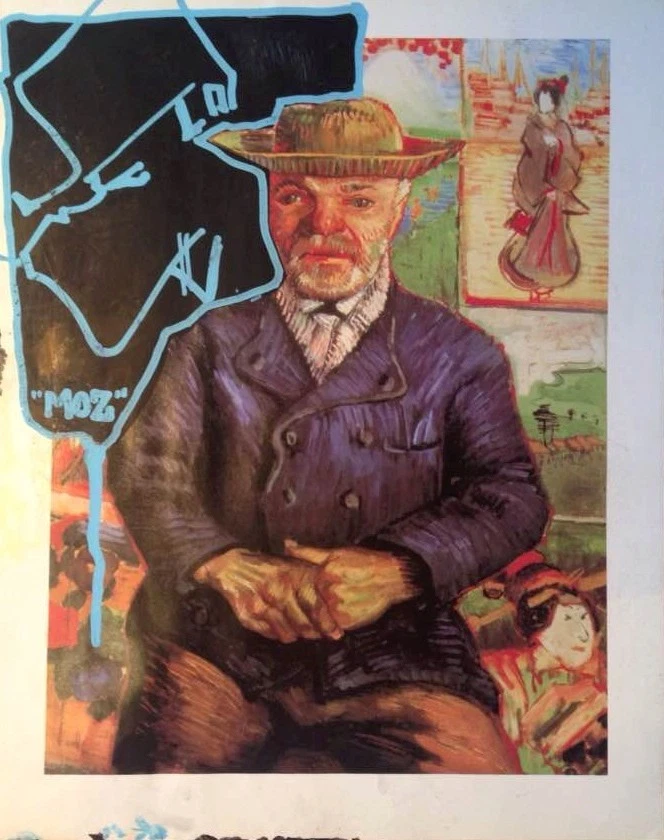
This composition features layers of black and blue abstract forms—characteristic of calligraffiti—superimposed onto a printed book page. The underlying page displays French text discussing art history, specifically mentioning Van Gogh and Japanese prints, alongside a reproduction of an Impressionist landscape painting. The black forms, outlined in a lighter tone, exhibit a bold, gestural quality, while the blue elements provide a contrasting, more solid background to these dynamic shapes.
The artwork integrates elements of text and imagery from its found substrate, creating a dialogue between historical art references and contemporary urban aesthetics. The visible text, “L’EXPÉRIENCE LA GRANDE VII 1885–1888,” suggests a historical context for the page itself, possibly from a publication on late 19th-century art. The abstract markings partially obscure and interact with the printed content, suggesting a reinterpretation or contemporary intervention on existing cultural material.
The piece also includes smaller, more linear black markings—some resembling stylized signatures or tags—further embedding it within the visual vocabulary of street art. These elements contribute to a sense of spontaneous creation and direct engagement with the surface, contrasting with the mass-produced nature of the underlying book page. The overall effect is a juxtaposition of different visual languages and temporal contexts.
Avis de l'expert
The artwork is situated within the broader context of the Street Art and Post-Graffiti movements, where artists appropriate and transform existing materials and imagery. The use of a book page as a substrate for abstract calligraffiti reflects a common practice in urban art of utilizing found objects and surfaces, thereby recontextualizing them. This approach often blurs the lines between traditional art media and street-derived techniques, appealing to collectors interested in works that bridge these categories.
In the art market, works by Moze 156 are typically sought after by collectors who appreciate the evolution of graffiti into abstract expression. His pieces are often exhibited in urban art galleries and contemporary art fairs, where they contribute to a segment of the market that values originality, technical skill derived from street practices, and a distinct visual identity. The integration of historical text and imagery in this particular work adds a layer of intellectual engagement, potentially enhancing its appeal to a diverse collector base.
À propos de l'artiste
MOZE 156, né à Paris, en France, est un graffeur reconnu pour sa contribution à la scène artistique urbaine depuis la fin des années 1980. Il est membre de plusieurs collectifs de graffeurs de renom, notamment 156 (qu’il a cofondé avec JonOne), TNB et TDT. Ses premières œuvres étaient axées sur le lettrage de graffiti, développant un style calligraphique distinct caractérisé par des lignes dynamiques et des formes de lettres complexes. Au fil des décennies, MOZE 156 a fait évoluer sa pratique, passant d’interventions clandestines dans la rue à un travail en atelier et à des expositions en galerie, tout en conservant l’énergie et l’esthétique de ses origines dans l’art de rue. Ses compositions présentent souvent des formes abstraites issues de ses lettrages de graffiti, ainsi que des éléments figuratifs tels que les profils stylisés que l’on retrouve dans certains de ses dessins. Il a exposé dans diverses galeries à l’international, contribuant ainsi à une plus large acceptation et à l’institutionnalisation de l’art du graffiti.
Informations complémentaires
Signé
3x
D'AUTRES OEUVRES SUR ARTRANSFER
Your Dynamic Snippet will be displayed here...
This message is displayed because you did not provide both a filter and a template to use.