Wolfgang Stiller
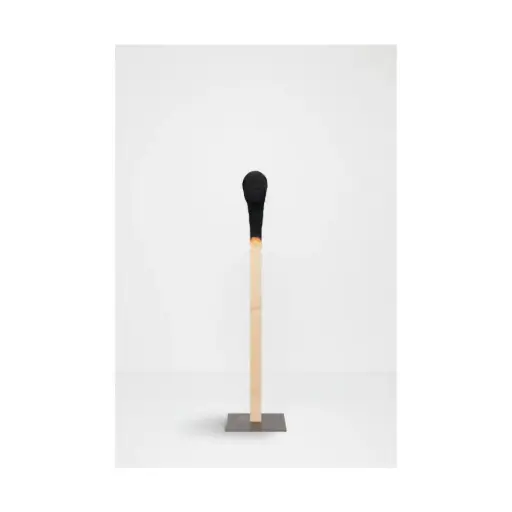
Wolfgang Stiller (b. 1961, Wiesbaden, Germany) is a contemporary German artist internationally renowned for his powerful sculptural installations exploring themes of human existence, mortality and burn-out. With a career spanning almost forty years, his work is distinguished by an approach to sculpture that is both physical and meditative, where body and matter become metaphors for a world exhausted by its own contradictions. Witness to the great changes of his time - from the fall of the Berlin Wall to cultural globalization - his works reflect a lucid, poetic view of the fragility of the human condition. Trained in visual communications at the GHS Wuppertal (1981-1984), then in visual arts at the Kunstakademie Düsseldorf (1984-1989), Stiller soon developed a practice in which material experimentation meets philosophical reflection. His international career has taken him to live and work in Istanbul (1996), New York (2000-2007), Beijing (2007-2008) - where he taught as a visiting professor at New York University Shanghai - before settling in Berlin, where he has lived since 2009. These multicultural experiences nourish a body of work of profound universal significance. His most emblematic series, entitled Matchstickmen, features monumental anthropomorphic matches whose charred heads, sculpted in wood and polyurethane, evoke inner combustion, finitude and the disappearance of vital energy. These sculptures, oscillating between tragedy and poetry, have become a visual symbol of contemporary burn-out, of the tension between creation and extinction. With over 140 exhibitions to his credit - including 55 solo and 85 group shows worldwide - Wolfgang Stiller is one of the most prolific European artists of his generation. His works are included in prestigious public and museum collections such as the Wuhan Museum of Fine Art (China), Pfalzgalerie Kaiserslautern, Museum Bochum, Osthaus-Museum Hagen and the Public Collection of the Land Hessen (Germany). Through his art, Stiller transforms matter into an existential mirror, reminding us that exhaustion, far from being an end, can become a form of spiritual rebirth.