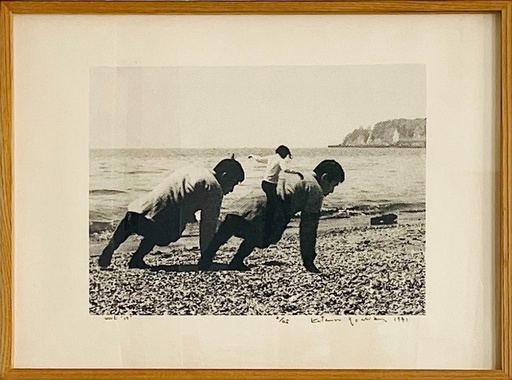
Katsuro Yoshida
Born in Saitama in 1943, Katsuro Yoshida was an artist who lived and worked in Japan until his death in 1999. A 1968 graduate of the Tama Art University, painting department, he became a central member of the Mono-Ha movement from 1968 to 1971, alongside Nobuo Sekine and Lee Ufan. These artists explored the relationship between natural or industrial materials and their environment, emphasizing direct perception rather than transformation or representation. Yoshida is also interested in the interaction between the human body and these elements, often in a performative context. Katsuro Yoshida therefore began by creating three-dimensional works with a strong materiality, and then, from 1969 onwards, by making serigraphs (and later photo engravings). Through his photographic and silkscreen experiments, Katsuro Yoshida played a fundamental role in the international conceptual art movement of the 1970s. He took part in events such as the 8th Japanese Contemporary Art Exhibition in 1968, "Mouvement d'art contemporain" in 69, "Section transversale d'art contemporain" in 70 and "Biennale de Paris" in 71. More recently, in 2017, he was exhibited at the Christophe Gaillard gallery in Paris for the "Japanese Conceptual Photography of the 70s" exhibition.