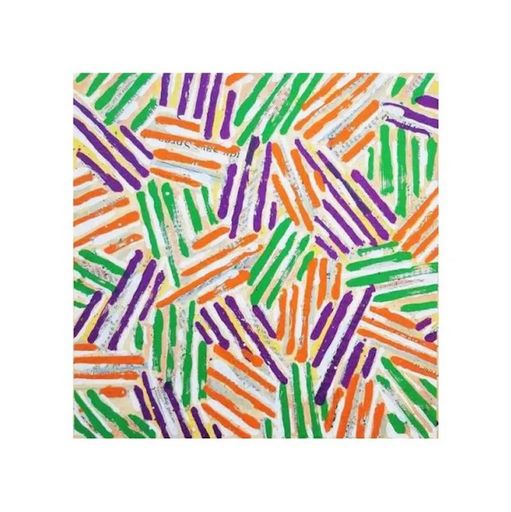
Jasper Johns
Jasper Johns, born in Augusta, Georgia, in 1930, is an American painter, sculptor, draftsman, and printmaker. He is recognized as a central figure in the development of American postwar art, having been associated with Abstract Expressionism, Neo-Dada, and Pop Art movements. Johns' career took a decisive turn in 1954 when he began creating paintings of flags, maps, targets, and numbers, which became his most recognized subjects. These works departed from the individualism of Abstract Expressionist style and questioned the nature of representation by incorporating familiar symbols. Johns' early mature work, from the mid- to late 1950s, introduced a style that influenced subsequent art movements, including Pop, Minimal, and Conceptual Art. He often used everyday symbols, which he described as "things the mind already knows," blurring the line between abstraction and representation. His collaborations with artists like Robert Rauschenberg and composers such as John Cage contributed to his influence across multiple creative disciplines. Johns has been the subject of numerous exhibitions at major museums globally, and his work is held in prominent collections. Printmaking has been a central aspect of Johns' practice since 1960, allowing him to explore repetition and variation. He has mastered lithography, screenprint, and various etching techniques, producing a body of over three hundred printed works. His long collaboration with Universal Limited Art Editions (ULAE) has resulted in an extensive collection of prints that rework his key motifs across different media. Johns' process in printmaking, which includes extensive proofing, provides insight into the central ideas of his art by recording the stages of an image's development.