Victor Vasarely
Babel
1978
Acrylic and water paint on poster
91 × 69 cm
Ed. /250
Location: France
Documents
-
Invoice or proof of purchase
-
Certificate of authenticity
-
Other documents
About the artwork
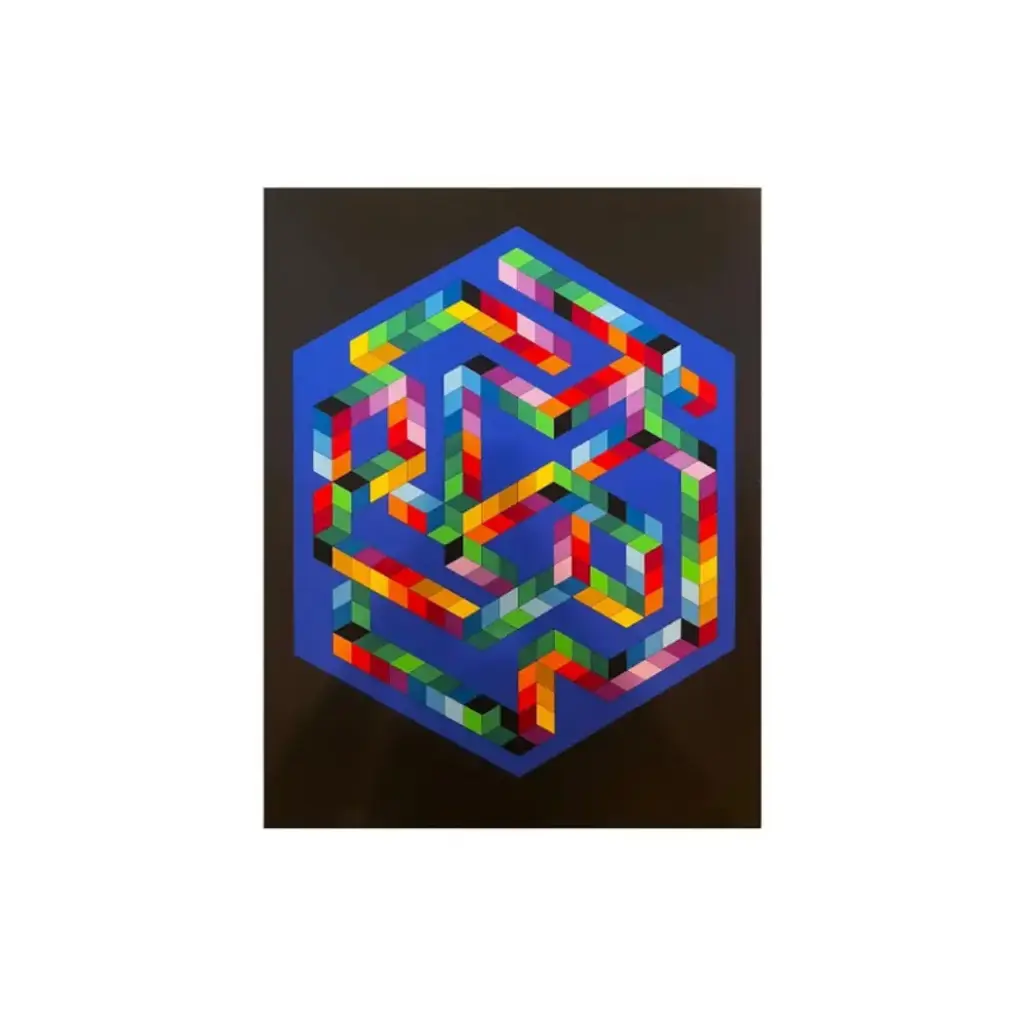
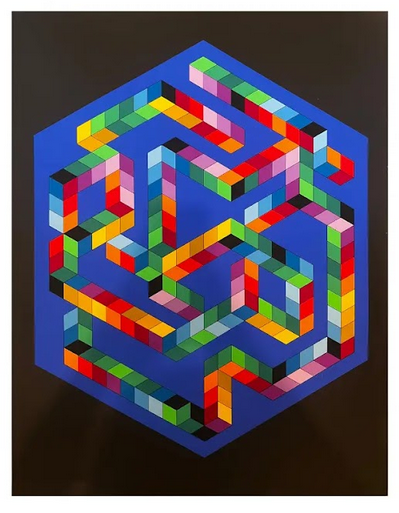
A hexagonal composition presents a complex, interlocking network of three-dimensional forms, rendered in a vibrant palette of primary and secondary colors. Each segment of the grid is depicted as a small, elongated cube, with varying shades of color used to suggest volume and perspective, creating an illusion of depth and movement across the flat surface. The interwoven pathways appear to recede and advance, forming an intricate maze-like structure that fills the blue hexagonal field. The background of the composition is a solid, deep blue hexagon, which itself is set against a dark, possibly black, border. The individual colored blocks, including reds, oranges, yellows, greens, blues, and purples, are arranged to form continuous, ribbon-like structures that twist and turn within the geometric confines. This arrangement generates an optical effect, where the eye perceives a dynamic interplay of forms and colors.
Expert opinion
This work exemplifies the principles of Op Art (Optical Art), a movement that emerged in the 1960s, focusing on abstract, geometric compositions designed to create optical illusions and sensations of movement. Victor Vasarely is considered a pioneer of this movement, and his works are foundational examples of its aesthetic and theoretical underpinnings. The use of precise geometric forms, contrasting colors, and systematic repetition in this piece is characteristic of his mature style. In the art market, Vasarely's prints and multiples, particularly those that clearly demonstrate his Op Art innovations, are consistently sought after. They represent an accessible entry point into collecting works by a historically significant artist whose influence extends beyond fine art into design and popular culture. The market values these editions based on their visual impact, condition, and the artist's enduring legacy within 20th-century abstraction.
About the artist
Victor Vasarely (1906-1997) was a Hungarian artist who in 1929 joined the Muhëly School in Budapest, recognized as the equivalent of the German Bauhaus school. He was profoundly influenced by the school's teaching, which introduced him to Constructivist trends and Abstract Art. Quickly bored by abstraction, he sought to "excite the eye" and depict active forms, focusing on both form and perception. In the 1950s, he participated in the creation of the first optical works of kinetic art, with productions that were initially black and white. In the same vein, he distinguished himself in contemporary art by creating a new trend: optical art. While Vasarely achieved notoriety during his lifetime, his work was omnipresent in France from the 60s and 70s onwards. He was as much the creator of the Renault logo as he was of a David Bowie album cover and several Parisian building decors. His work is included in the permanent collections of major museums such as the Centre Georges Pompidou (Paris) and the Museum of Modern Art (San Francisco). Before his death, with the help of his wife, Victor Vasarely established the Vasarely Foundation in Aix-en-Provence, where some of his works have since been conserved.
“"Outside of me, the universe is painful, hostile, dangerous." - Victor Vasarely on his practice”
Additional info
Signed
OTHER ARTWORKS YOU MAY LIKE
Your Dynamic Snippet will be displayed here...
This message is displayed because you did not provide both a filter and a template to use.